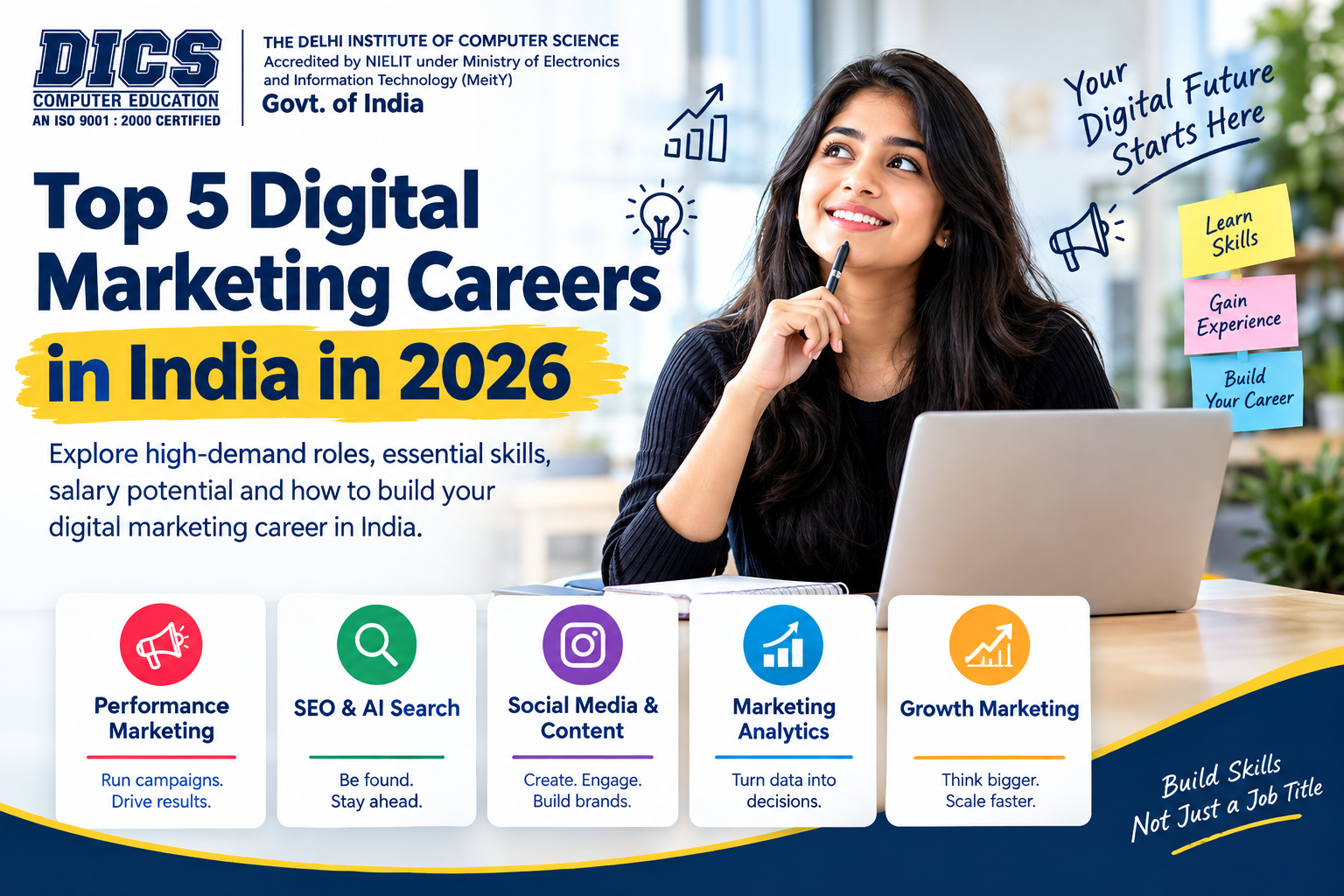
TOP 5 CAREERS IN DIGITAL MARKETING IN INDIA 2026
Written by:
-
dicsindia
Digital marketing has become one of the most exciting career fields in India. From startups and e-commerce companies to educational institutions, real estate businesses, healthcare brands and established enterprises, businesses are investing heavily in digital channels to find customers and grow their brands.
And here’s what makes 2026 particularly interesting: digital marketing is no longer just about social media posting or writing blogs.
AI is changing how marketers research audiences, create content, analyse campaigns, automate repetitive tasks and understand customer behaviour. At the same time, businesses still need people who understand marketing fundamentals and can turn technology into measurable results.
This has opened up several career paths for students, graduates, working professionals and people looking to switch careers.
If you’re researching digital marketing careers India, you might be wondering:
- Is digital marketing a good career in 2026?
- Which digital marketing jobs are in demand?
- What skills should I learn?
- Can freshers get digital marketing jobs?
- What is the salary potential?
- How is AI changing digital marketing careers?
In this guide, we’ll explore the top 5 digital marketing career opportunities in India in 2026, the skills required for each role, who should consider them and how you can start building a career in this rapidly changing industry.
Table of Contents
1. Performance Marketing Specialist
If you enjoy numbers, advertising, experimentation and measurable results, performance marketing could be one of the best career options for you.
Performance marketing is focused on achieving specific business outcomes through paid digital campaigns. Instead of simply asking how many people saw an advertisement, performance marketers focus on questions such as:
How many leads did we generate?
How much did each lead cost?
Which campaign generated the most sales?
What was our return on advertising spend?
Performance marketers commonly work with platforms such as Google Ads, Meta Ads and YouTube Ads. They research keywords and audiences, create campaigns, test advertisements, monitor performance and optimise budgets.
What does a performance marketer do?
A performance marketing professional may be responsible for:
- Google Ads campaign management
- Meta Ads campaign management
- Keyword research
- Audience research
- Ad copywriting
- Creative testing
- Conversion tracking
- Landing-page optimisation
- A/B testing
- Budget management
- Campaign reporting
- ROI and ROAS analysis
For example, imagine an education company wants to generate enquiries for a digital marketing course in Delhi.
A performance marketer could target users searching for terms related to digital marketing courses, create relevant advertisements, send users to a conversion-focused landing page and track how many enquiries are generated.
The marketer can then analyse which keywords and advertisements are producing quality leads and move the budget toward better-performing campaigns.
That’s why performance marketing requires more than knowing how to click buttons inside an advertising platform.
You need to understand customers, competition, numbers, creative strategy and conversion psychology.
Skills required for performance marketing
If you want to pursue this career, consider learning:
- Google Ads
- Meta Ads
- YouTube advertising
- Keyword research
- Conversion tracking
- Google Analytics 4
- Landing-page optimisation
- Copywriting
- Excel
- Data analysis
- A/B testing
- AI-assisted marketing
AI can also help performance marketers with research, creative variations, data analysis and reporting. However, the marketer still needs to understand the business objective and make strategic decisions.
Who should choose performance marketing?
Performance marketing may suit you if you:
- Enjoy numbers and analytics
- Like experimentation
- Want measurable results
- Are interested in business
- Enjoy advertising
- Like solving problems
A possible career progression could look like:
Digital Marketing Intern → PPC Executive → Performance Marketing Specialist → Performance Marketing Manager → Growth Marketer → Consultant
2. SEO & AI Search Specialist
Search engine optimisation remains an important digital marketing career path, but SEO in 2026 is much broader than traditional keyword optimisation.
Search behaviour is changing rapidly. Users can discover businesses and information through traditional search engines, local search, social platforms and AI-powered search experiences.
As a result, modern SEO professionals need to understand not only how websites rank but also how information is discovered, interpreted and presented across different search environments.
This has created opportunities in areas such as:
- Technical SEO
- On-page SEO
- Local SEO
- E-commerce SEO
- Content SEO
- International SEO
- AEO
- GEO
- AI-assisted SEO
What does an SEO specialist do?
An SEO professional may work on:
- Keyword research
- Search-intent analysis
- Competitor research
- Technical SEO audits
- On-page optimisation
- Internal linking
- Content strategy
- Local SEO
- Google Business Profile optimisation
- Schema markup
- Search Console analysis
- Website performance
- Link-building strategies
- AI-search visibility
For example, suppose someone searches:
“Best digital marketing institute in Delhi.”
An SEO professional shouldn’t simply repeat that keyword throughout a page.
They need to understand what the searcher actually wants.
Are they looking for course information?
Fees?
Reviews?
Placement assistance?
Location?
Course duration?
Career opportunities?
The better an SEO professional understands search intent, the better they can create content and website experiences that genuinely answer the user’s needs.
SEO and AI in 2026
AI has made content production much faster.
But faster content production doesn’t automatically mean better SEO.
When anyone can generate thousands of words quickly, valuable SEO professionals become the people who can provide:
- Original insights
- Accurate information
- First-hand experience
- Strong content structure
- Search-intent understanding
- Technical expertise
- Useful examples
- Genuine expertise
AI can assist with repetitive SEO tasks, but strategic thinking remains extremely important.
Skills required for an SEO career
You should consider learning:
- Google Search Console
- Google Analytics 4
- Keyword research
- Technical SEO
- On-page SEO
- Local SEO
- Content strategy
- Internal linking
- Schema
- Basic HTML
- Competitor analysis
- AI-assisted SEO
- AEO
- GEO
- Excel and data analysis
Who should choose SEO?
SEO is a good option if you enjoy:
- Research
- Websites
- Writing
- Data
- Problem-solving
- Competitor analysis
- Long-term strategy
A typical career progression can be:
SEO Intern → SEO Executive → SEO Specialist → SEO Manager → SEO Consultant → SEO Strategist
3. Social Media & Content Strategist
If you are creative, understand social media trends and enjoy creating content, social media marketing could be a strong career option.
But modern social media marketing is much more than publishing posts.
A professional social media strategist needs to understand:
Content + Audience + Platform + Branding + Analytics + Conversion
A company might have thousands of followers but very few enquiries. Another business may have a smaller audience but generate significantly more customers.
The difference often comes down to strategy.
What does a social media professional do?
Depending on the company, responsibilities can include:
- Social media strategy
- Instagram management
- Facebook marketing
- LinkedIn marketing
- YouTube strategy
- Short-form video
- Reel concepts
- Copywriting
- Content calendars
- Community management
- Influencer marketing
- Trend research
- Social analytics
- Paid social campaigns
One of the most valuable skills in 2026 is understanding how to create content that earns attention quickly.
For example, instead of starting a Reel with:
“Today we’re going to discuss digital marketing.”
a marketer might begin with:
“Still looking for a career that can grow with AI?”
The second opening creates curiosity and gives the viewer a reason to continue watching.
AI and social media marketing
AI can help social media professionals with:
- Content ideas
- Reel scripts
- Caption drafts
- Content calendars
- Audience research
- Content repurposing
- Creative variations
- Campaign analysis
- Research and brainstorming
But successful social media marketing still requires creativity.
AI can help produce content faster. It doesn’t automatically know what will make a particular audience stop scrolling.
That’s where human understanding of culture, emotion, storytelling and audience psychology becomes important.
Skills required
Consider learning:
- Social media strategy
- Copywriting
- Short-form video
- Content marketing
- Canva or graphic design fundamentals
- Video editing basics
- Social analytics
- Influencer marketing
- Meta Ads
- AI content tools
- Branding
Who should choose social media marketing?
This career could be right for you if you’re:
- Creative
- Comfortable with communication
- Interested in trends
- Good at storytelling
- Interested in video
- Curious about audience behaviour
A possible career path is:
Social Media Intern → Social Media Executive → Social Media Specialist → Social Media Manager → Content Strategist → Brand/Social Media Consultant
4. Marketing Analytics & AI Marketing Specialist
One of the most valuable combinations emerging in modern marketing is:
Marketing + Data + AI
Businesses don’t just want to know how many people visited their website.
They want to know:
Where did those visitors come from?
Which campaign generated the lead?
Which channel generated the highest-quality customers?
How much did it cost to acquire each customer?
Where are potential customers dropping out of the conversion process?
This is where marketing analytics becomes extremely valuable.
What does a marketing analytics professional do?
Depending on the organisation, the role can involve:
- Website analytics
- Campaign reporting
- Conversion analysis
- Customer segmentation
- Dashboard creation
- Marketing attribution
- Data visualisation
- Campaign performance analysis
- CRM analysis
- Marketing automation
Tools commonly used in this area include:
- Google Analytics 4
- Google Search Console
- Looker Studio
- Excel
- SQL
- CRM platforms
- Advertising dashboards
- AI tools
Imagine an education company receives 1,000 leads.
Simply knowing that there are 1,000 leads isn’t enough.
An analyst might discover that:
- Search generated fewer leads but higher-quality enquiries.
- Social media generated more leads but lower conversion rates.
- One campaign generated the highest revenue.
- A particular landing page had a significantly better conversion rate.
These insights allow businesses to make better marketing decisions.
How AI is changing marketing analytics
AI is increasingly becoming part of the marketing workflow.
It can assist with:
- Data analysis
- Reporting
- Pattern identification
- Customer segmentation
- Campaign insights
- Content personalisation
- Forecasting
- Automation
- Research
The important skill isn’t simply knowing how to use an AI tool.
It’s understanding what question you need the data to answer.
Who should choose marketing analytics?
This career is particularly suitable if you enjoy:
- Numbers
- Technology
- Excel
- Data
- Logical thinking
- Problem-solving
- Business strategy
A possible progression is:
Marketing Analyst → Digital Marketing Analyst → Marketing Analytics Specialist → Growth Analyst → Marketing Manager → Growth Strategist
5. Digital Marketing Consultant & Growth Marketer
After gaining experience across different digital channels, some professionals move toward growth marketing and consulting.
This is where digital marketing becomes much more business-focused.
Instead of looking only at SEO, advertising or social media, growth marketers examine the entire customer journey.
Think about:
Traffic → Engagement → Lead → Conversion → Customer → Retention
A company might have excellent website traffic but poor conversion rates.
Another company might generate thousands of leads but struggle to convert those leads into customers.
A growth marketer looks for the bottleneck.
What does a growth marketer work on?
Depending on the organisation, responsibilities may include:
- SEO
- Performance marketing
- Content
- Social media
- Email marketing
- CRM
- Conversion optimisation
- Landing pages
- Analytics
- Marketing automation
- Customer retention
- AI workflows
The role requires a broader understanding of marketing than a single-channel specialist.
Why consulting can be attractive
Once you have strong skills and experience, you may choose to work independently.
You could provide services to:
- Startups
- E-commerce brands
- Educational institutions
- Real estate businesses
- Local businesses
- D2C companies
- Professional service businesses
You can work as a freelancer, consultant or eventually build your own digital marketing agency.
However, successful consulting requires more than technical knowledge.
Clients want business outcomes.
They want to know:
How many qualified leads did you generate?
Did sales improve?
Did customer acquisition costs decrease?
Did organic traffic grow?
Did conversions improve?
That’s why building a portfolio of real projects and case studies is so valuable.
Which Digital Marketing Career Is Right for You?
| Career Path | Best Suited For | Important Skills |
|---|---|---|
| Performance Marketing | Analytical thinkers | Google Ads, Meta Ads, Analytics |
| SEO & AI Search | Researchers and problem-solvers | SEO, Content, Technical SEO, AI Search |
| SocialMedia& Content | Creative people | Content Creation, Video, Communication |
| Marketing Analytics | Data-oriented people | GA4, Excel, SQL, AI & Data Analysis |
| Growth Marketing | Strategic thinkers | Full-Funnel Marketing, Analytics, CRO |
How to Start a Digital Marketing Career in India
You don’t need to wait until you know everything before starting.
Follow a practical learning path.
Step 1: Understand digital marketing fundamentals
Learn how customers move from awareness to consideration and finally to conversion.
Understand the role of SEO, advertising, content, social media and analytics.
Step 2: Choose a specialisation
Start with one core area.
For example:
SEO + AI or Google Ads + Meta Ads or Social Media + Content or Analytics + AI
Once you have a foundation, add complementary skills.
Step 3: Work on real projects
Theory alone isn’t enough.
Create practical projects for a website, local business, personal brand, e-commerce concept or educational project.
Track what you do.
Step 4: Build a portfolio
Your portfolio could include:
- SEO audits
- Keyword research
- Website optimisation
- Google Ads campaigns
- Meta Ads campaigns
- Content calendars
- Social media campaigns
- Analytics dashboards
- Landing pages
- Case studies
Step 5: Apply for internships and entry-level positions
Don’t wait for the perfect job.
A good internship can give you exposure to:
- Real clients
- Campaigns
- Budgets
- Reporting
- Teamwork
- Deadlines
Step 6: Keep upgrading your skills
Digital marketing changes continuously.
Platforms change.
Algorithms change.
AI changes workflows.
Consumer behaviour changes.
The professionals who continue learning are better positioned to adapt.
Frequently Asked Questions
Yes. Digital marketing offers career opportunities across SEO, paid advertising, social media, analytics, content, e-commerce and AI-powered marketing. The field is also evolving quickly, creating opportunities for professionals who continuously upgrade their skills.
Yes. Freshers can enter the industry through internships and junior positions. A strong portfolio, practical projects and relevant skills can help demonstrate your capabilities to employers.
There isn’t one answer for everyone. Performance marketing, SEO, social media, analytics and growth marketing all offer different career paths. Your choice should depend on your interests, strengths and long-term goals.
Yes. Students can start learning digital marketing while studying and build practical projects before graduation. Developing a portfolio can help them demonstrate their skills when applying for internships and entry-level jobs.
A degree can be useful, but digital marketing also requires practical skills. Employers may consider experience, portfolio projects, certifications and demonstrated results alongside educational qualifications.
AI is changing digital marketing, but marketing still requires strategy, creativity, communication, customer understanding and decision-making. Professionals who learn how to use AI effectively may be better positioned to work alongside these technologies.
Yes. After developing sufficient skills and experience, professionals can offer services such as SEO, paid advertising, social media management, content marketing and analytics as freelancers or consultants.
-
 AI Automation in 2026: Skills, Tools, Careers & How to Start16 Sep 2026 Blogs
 -
TOP 5 CAREERS IN DIGITAL MARKETING IN INDIA 202608 Sep 2026 Blogs
-
 NIELIT Certification in 2026: Everything You Need to Know Before You Enroll23 Apr 2026 Blogs
 -
 Best Skills to Learn in 2026 with AI for High Income11 Apr 2026 Blogs
 -
 ChatGPT + Digital Marketing: How to Actually Use AI to Grow Your Brand in 202607 Apr 2026 Blogs
- Digital Marketing & Analytics
- Certificate in Data Analytics
- Full Stack Web Development
- Financial Accounting
- Master in Animation

Explore Our Expert-Written Latest Articles to Boost Your Knowledge
Read our expert-written latest articles to stay updated with industry trends, enhance your knowledge, and boost your skills for career growth.
AI Automation in 2026: Skills, Tools, Careers & How to Start Written by: Artificial intelligence is changing the way people work—but in 2026, simply knowing
Written by: Digital marketing has become one of the most exciting career fields in India. From startups and e-commerce companies to educational institutions, real estate
Written by: Most students in Delhi hear “NIELIT,” they either think it’s just that CCC certificate their college made them get, or they have no


