Written by: Digital marketing has become one of the most exciting career fields in India. From startups and e-commerce companies to educational institutions, real estate
Written by:
Artificial intelligence is changing the way people work—but in 2026, simply knowing how to use an AI chatbot is no longer the whole story.
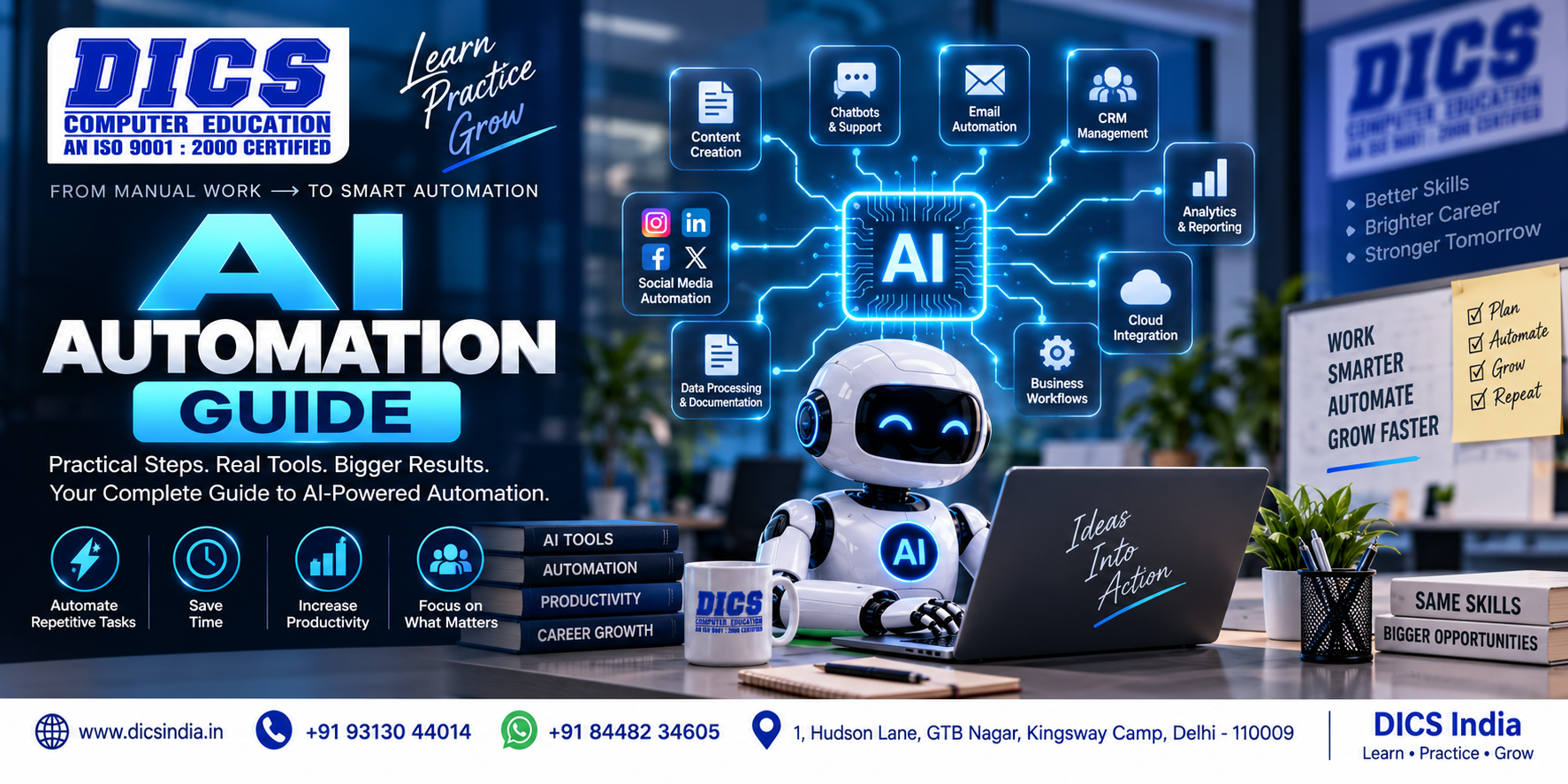
The bigger opportunity is AI automation: connecting AI with software, data and business processes so that repetitive tasks and workflows can be completed with less manual effort.
From marketing and sales to customer support, reporting and operations, businesses are exploring ways to integrate AI into everyday workflows.
That creates a practical question:
What exactly is AI automation, what skills do you need, and how can a beginner start learning it?
This guide explains everything from AI workflows and automation tools to career opportunities and a practical learning roadmap.
AI automation is the use of artificial intelligence together with automation technologies to perform tasks, process information, generate outputs and manage workflows with limited manual intervention.
Unlike traditional automation, which usually follows fixed rules, AI automation can work with more variable inputs such as natural language, documents and unstructured information.
For example: Traditional automation: Form submitted → Send email
AI automation: Form submitted → AI understands the enquiry → Classifies the lead → Generates a response → Updates CRM → Notifies the sales team
The goal is not simply to replace people. It is to make workflows faster, more scalable and easier to manage while keeping appropriate human oversight.
Automation isn’t new. Businesses have been automating emails, spreadsheets, invoices, notifications and data entry for years.
What’s changing is the type of work that can be included in an automated process. Earlier automation generally worked best when the input was predictable.
For example: If a customer completes this form, send this email. AI can make the workflow more flexible. A customer might write:
“Hi, I’m looking for a Python course. I’m a college student and I don’t know whether I should start with Python or data analytics.”
That isn’t a simple checkbox.
An AI system can analyse the message, identify the subjects being discussed and route the enquiry accordingly. This doesn’t mean the AI should make every decision by itself.
In many real-world situations, the better approach is:
AI handles the repetitive interpretation → automation moves the information → a human handles important decisions.
That human-AI combination is becoming an important part of workplace discussions. The World Economic Forum has noted that organisations need to redesign work around AI while retaining human oversight, process knowledge and decision-making.
A typical AI automation workflow has several parts.
Something starts the process.
It could be:
The system receives information.
For example:
Name: Rahul
Course interest: Python
Question: “Is it suitable for someone with no programming background?”
An AI model interprets the information.
It might determine:
The workflow decides what happens next.
For example:
Send the enquiry to the admissions team.
or:
Add the lead to the appropriate CRM category.
The workflow completes the task.
That could mean:
This is the basic architecture behind many AI automation systems.
| Traditional Automation | AI Automation |
|---|---|
| Usually follows fixed rules | Can interpret less-structured information |
| Works well with predictable inputs | Can work with text, documents and natural language |
| Uses “If X, then Y” logic | AI can analyse information before deciding the next step |
| Usually deterministic | AI outputs can vary |
| Easier to test | Requires additional monitoring and validation |
| Useful for repetitive processes | Useful when understanding information is part of the process |
There isn’t one industry called “AI automation.”
The same basic idea can be applied to many different types of work.
Marketing teams can use AI automation for tasks such as:
The human marketer still needs to decide what the brand should say and whether the output is actually useful.
AI automation can help with:
For sensitive or complicated situations, human review remains important.
Sales teams can automate parts of:
The objective isn’t simply to send more messages.
It’s to reduce administrative work so salespeople can spend more time on conversations that actually require them.
Automation can assist with repetitive processes such as:
Financial workflows require particular care because incorrect information can have real consequences.
Possible applications include:
Again, automation should not automatically become the final decision-maker for important employment decisions.
Content teams can use AI automation to help with:
The important word here is help.
A content workflow still needs editorial judgement.
This is where beginners sometimes make a mistake. They assume AI automation is mostly about learning tools. It isn’t. Tools change quickly. The underlying skills are more useful.
Understand what AI models can and cannot do. You should know the difference between:
You don’t necessarily need advanced mathematics to begin.
If you’re working with language models, you need to know how to give them useful instructions. Good prompting isn’t simply writing long prompts.
It involves:
This may be the most underrated skill. Before building anything, ask:
What happens first?
What information is needed?
What happens next?
Where can something go wrong?
When does a human need to intervene?
That is process thinking. And it matters more than memorising the buttons inside an automation platform.
You don’t have to become a full-stack developer to understand APIs. But learning what an API does can make automation much easier to understand. An API essentially allows different software systems to communicate.
For example:
Website → API → AI service → CRM
That simple concept opens up many possibilities.
Automation is only as good as the information moving through it. You should understand basic concepts such as:
Coding is not mandatory for every automation project. But basic programming knowledge can become extremely useful when you want to build more advanced workflows. Learning some Python or JavaScript, for example, can help you understand:
At DICS, the focus should not be on teaching students a list of trendy AI tools and sending them home with a certificate. AI automation makes more sense when students understand why a workflow exists in the first place. A practical learning approach can include:
The goal is simple:
Understand the problem → design the workflow → build it → test it → improve it.
For students who want structured learning, explore the AI Automation Learning Course at DICS and related AI courses available through the institute.
AI automation means using AI inside an automated workflow to understand information, generate outputs, classify data or assist with decisions and actions.
The basics are approachable for beginners. The difficulty increases as workflows become more complex and involve APIs, databases, programming, security and multiple systems.
No. Many beginner workflows can be created using visual or no-code tools. Coding becomes increasingly useful for advanced customisation and integrations.
Python is a practical starting point because it is widely used for AI, data processing and API-based applications. JavaScript can also be useful, particularly for web-based systems.
AI automation can change the tasks people perform and may reduce the need for some repetitive work. At the same time, organisations can create new responsibilities around AI implementation, oversight, data, technology and business processes. The impact varies by industry and role.
AI provides capabilities such as understanding or generating information. Automation connects steps and makes processes run automatically. AI automation combines the two.
Yes. Potential applications include lead classification, reporting, research, content workflows, campaign data analysis and repetitive marketing operations. Human review remains important for strategy and quality.
Read our expert-written latest articles to stay updated with industry trends, enhance your knowledge, and boost your skills for career growth.

Written by: Digital marketing has become one of the most exciting career fields in India. From startups and e-commerce companies to educational institutions, real estate

Written by: Most students in Delhi hear “NIELIT,” they either think it’s just that CCC certificate their college made them get, or they have no

Written by: If you’ve been thinking about your career lately — maybe feeling confused, stuck, or unsure about what to do next — you’re not
Take the first step towards a smarter Future 🚀