


ChatGPT + Digital Marketing: How to Actually Use AI to Grow Your Brand in 2026

Written by:

India is now the second-largest ChatGPT market in the world. Over 100 million people use it every single week in this country alone. And a lot of them are marketers, freelancers, small business owners, and students who’ve figured out that AI isn’t just a shortcut — it’s a skill.

If you’re working in digital marketing (or trying to break into it), understanding how to actually use ChatGPT — not just open it and type — is quickly becoming non-negotiable. This guide breaks it all down in plain language. No jargon, no fluff. Just what works

Table of Contents

What Is ChatGPT, and Why Should Marketers Care?

ChatGPT is an AI tool made by OpenAI. You type something, it responds with text that sounds human. That’s the basic idea.

But here’s why marketers love it: marketing is fundamentally a writing job. You’re always writing something — an ad, a post, a blog, an email, a script. And ChatGPT is very, very good at writing.

It doesn’t get tired at 11pm. It doesn’t stare at a blank page for 20 minutes. It doesn’t have “off” days. You give it context, you give it a clear prompt, and it gets to work.

Now — does that mean you can just let it run and sit back? Absolutely not. (More on that later.) But used well, it can genuinely cut your workload in half. Sometimes more.

7 Real Ways Digital Marketers Are Using ChatGPT in 2026

  1. Writing Blog Content Without the Blank Page Problem

    Ask any content writer what the hardest part of the job is. Almost everyone says the same thing — getting started.

    ChatGPT solves that. You give it a topic, a target audience, a keyword, and a tone — and it gives you a first draft. Not a perfect draft. But a starting point that’s miles better than a blinking cursor.

    Here’s a prompt that actually works:

    > *”You are an SEO content writer. Write a 1,500-word blog post titled ‘Top 5 Digital Marketing Career Opportunities in India in 2026’. Use a conversational tone. Include an intro, 5 H2 sections, and a conclusion with a CTA. Target keyword: digital marketing careers India.”*

    You’ll still need to edit it. Add a real example. Maybe swap out a sentence that sounds off. But what used to take four hours? Now takes under an hour. That’s not nothing.

     2. Social Media Content — Captions, Calendars, the Whole Thing

    Coming up with fresh content every single day is genuinely exhausting. Most social media managers will tell you that the ideation part is harder than the writing part.

    ChatGPT can take that off your plate pretty quickly.

    Try something like:

    > *”Create a 30-day Instagram content calendar for a digital marketing institute in Delhi. Mix educational posts, student success stories, motivational content, and course promos. Write the captions too.”*

    What you get back isn’t perfect. Some captions will be a bit flat. But you’ve now got a working calendar in 10 minutes instead of two days. You tweak what doesn’t feel right, keep what does, and move on.

    You can also tell it the platform and tone. “Write for Instagram Reels, Gen Z audience, very casual” gives you completely different output than “LinkedIn post, professional tone, thought leadership angle.” The specificity matters.

    3. Ad Copy — Google, Meta, All of It

    This one is huge. Writing ad copy is a skill that takes years to develop — and even experienced performance marketers spend a lot of time on headline and copy variations.

    ChatGPT makes the iteration process so much faster.

    For Google Ads specifically:

    > *”Generate 10 headline variations and 5 descriptions for a digital marketing course in Delhi. Headlines must be under 30 characters. Focus on career outcomes, placement support, and urgency.”*

    For Meta, you can ask for full ad sets — primary text, headline, CTA — for cold audiences, warm audiences, and retargeting separately. Each one with different angles.

    Does it always nail it on the first try? No. But it gives you raw material to work with, and that’s often the hardest part.

     4. Keyword Research and Content Clusters

    Here’s something most people don’t realise: ChatGPT is genuinely useful for early-stage SEO thinking.

    It’s not a replacement for tools like SEMrush or Ahrefs — you still need those for actual search volume data. But for brainstorming keyword ideas, grouping them by intent, and mapping out a content structure? It’s surprisingly good.

    You can ask it:
    – “Give me 20 long-tail keywords around ‘digital marketing courses in Delhi'”
    – “Group these keywords by search intent — informational, commercial, transactional”
    – “Suggest a pillar page and 8 cluster pages for the topic of digital marketing careers”

    That last one especially. Content clustering is a powerful SEO strategy that a lot of smaller sites ignore because it feels complicated. ChatGPT makes planning it out feel a lot more approachable.

     5. Email Sequences That Don’t Sound Like a Robot Wrote Them

    (The irony of this heading is not lost on me.)

    Email marketing still has one of the best ROIs of any digital channel. But building out a full welcome sequence or nurture campaign from scratch is a grind.

    Prompt example:

    > *”Write a 5-email welcome sequence for students who’ve shown interest in a digital marketing course. Email 1 is a warm welcome. Emails 2–4 are educational with some social proof. Email 5 is a soft enrollment CTA. Tone: warm, encouraging, not salesy.”*

    The output will need editing — especially to remove phrases that sound overly formal or a little too “AI-ish.” But the structure is there, the flow is there, and you’re editing instead of building from zero.

    6. Understanding Your Audience Before You Write a Word

    This one gets overlooked. People use ChatGPT to write content — but you can also use it to think through *who* you’re writing for before you start.

    Ask it to build a customer persona. Describe your typical student or client and let it map out their motivations, pain points, objections, and the kind of language they respond to. It won’t always be spot-on — especially for niche Indian audiences — but it’s a useful thinking exercise that helps you write with more focus.

    You can also use it to prep for competitor research. “What are the common objections students have when choosing a computer institute?” is a surprisingly useful prompt. The answers aren’t based on real data, but they’ll prompt thinking you might not have done on your own.

     7. Building a Consistent Brand Voice

    This might be the most underrated thing you can do with ChatGPT — and most people never try it.

    When you give ChatGPT a generic prompt, you get generic output. But when you give it examples of your existing writing and say “match this tone,” the quality jumps significantly.

    Before your next prompt, paste 2–3 pieces of content your brand has already published and add: *”This is the tone and style we write in. Match this for everything you create for us.”*

    The difference is noticeable. Especially if your brand has a distinctive voice — punchy, warm, direct, whatever it is — this technique makes AI-generated content feel genuinely on-brand.

Learn Digital Marketing with DICS India

Can ChatGPT Replace a Digital Marketer?

people who use AI well are starting to outperform people who don’t. Not because AI is smarter — but because they’re moving faster, producing more, and spending their mental energy on strategy instead of first drafts.

There are things ChatGPT flat-out cannot do. It can’t build real relationships with your audience. It doesn’t understand your business the way you do. It can’t make judgment calls about what a client really needs, or read the room in a campaign that’s going sideways. It also gets things wrong — including facts — so you always need to verify anything data-specific.

ChatGPT handles the work that slows you down. You handle the thinking that actually matters.

Kickstart Your Digital Marketing Career Today

Is Learning ChatGPT Enough to Land a Marketing Job?

no, Knowing how to use ChatGPT is not a career. It’s a tool, like knowing how to use Canva or Google Analytics. It becomes valuable when it’s sitting on top of actual marketing knowledge — how campaigns work, how to read data, how to build strategy, what makes content convert.

Employers in 2026 aren’t dazzled by someone who can write a ChatGPT prompt. They want someone who understands why a campaign worked, what the numbers mean, and how to fix it when it doesn’t.

That’s why structured learning still matters. At DICS India, the Digital Marketing Course is built to give you both — the core skills and the AI tools, applied through live projects with real feedback. Not just theory. Not just tool demos. Actual practice, with 100% placement support and connections to 300+ hiring companies.

If you’re serious about digital marketing as a career, that foundation is what makes the difference.

Take the Next Step Toward a Practical Tech Career
If learning excites you but direction feels unclear, we can help. Our programs are built to turn curiosity into confidence through hands-on training and real-world guidance.

Roles and Specializations in Digital Marketing

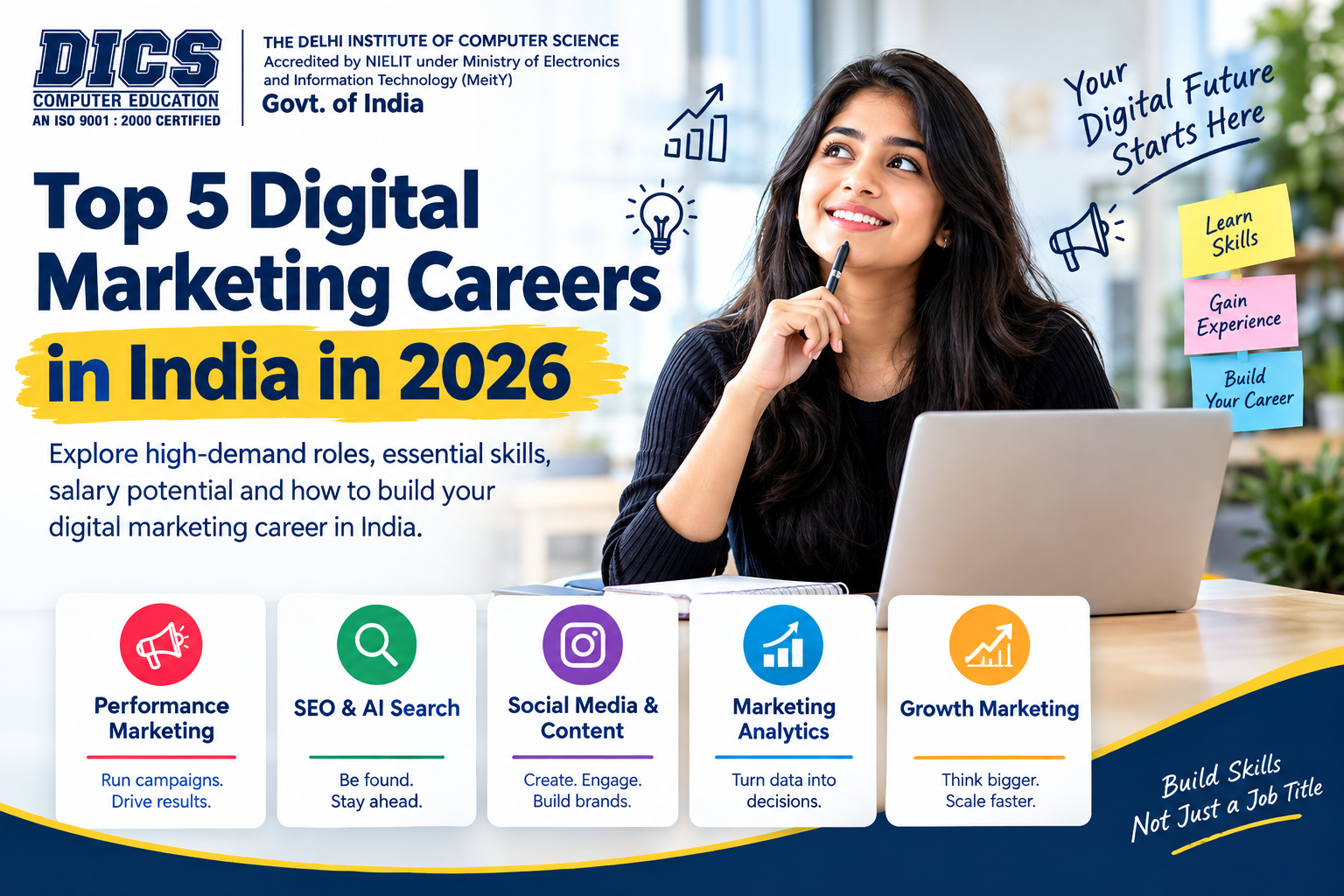
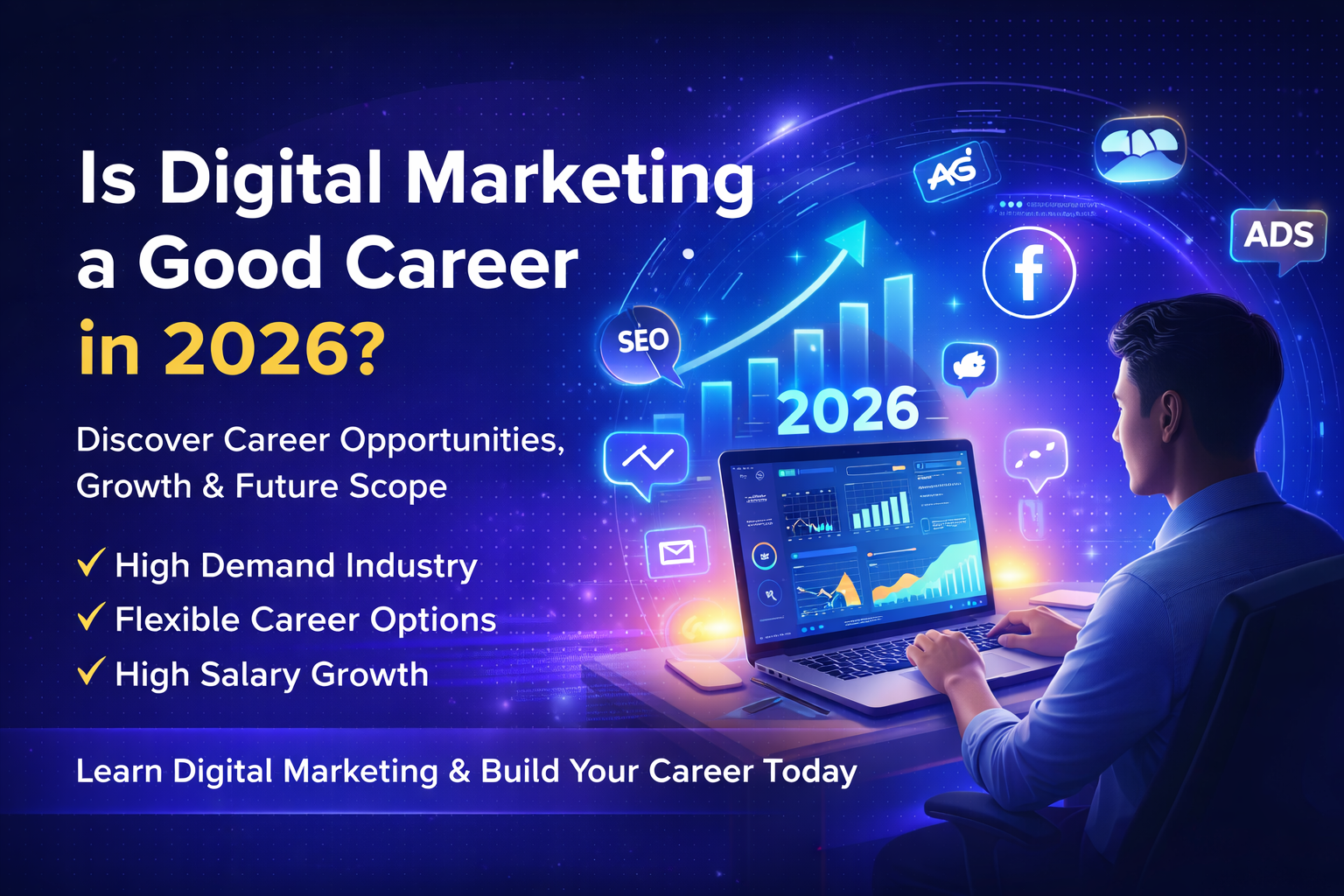
One of the biggest advantages of this field is the variety of roles available in 2026. Instead of a single “digital marketer” role, there is now a full ecosystem of specializations

Some of the in-demand roles include:

  • SEO Specialist / SEO Manager – focuses on improving a website’s visibility on search engines through on-page optimization, technical SEO, and backlink strategies.
  • Performance Marketing / PPC Expert – runs data-driven campaigns on Google Ads, Meta Ads, and other platforms to achieve measurable ROI in the form of leads or sales.
  • Social Media Manager / Social Media Strategist – builds brand presence on platforms like Instagram, YouTube, LinkedIn, and others through content planning and community engagement.
  • Content Writer / Content Strategist – creates blogs, landing pages, scripts, and email content that align with SEO goals and brand voice.
  • Marketing Automation / Email Marketing Specialist – designs workflows, drip campaigns, and segmentation strategies using tools like Mailchimp, HubSpot, or similar platforms.
  • Analytics and Data Specialist – interprets campaign metrics, attribution models, dashboards, and user behaviour data to guide decision-making.

This variety allows different personality types—creative writers, analytical thinkers, communication-focused individuals, and tech-savvy problem solvers—to find a niche that matches their strengths.

Impact of AI on Digital Marketing Careers

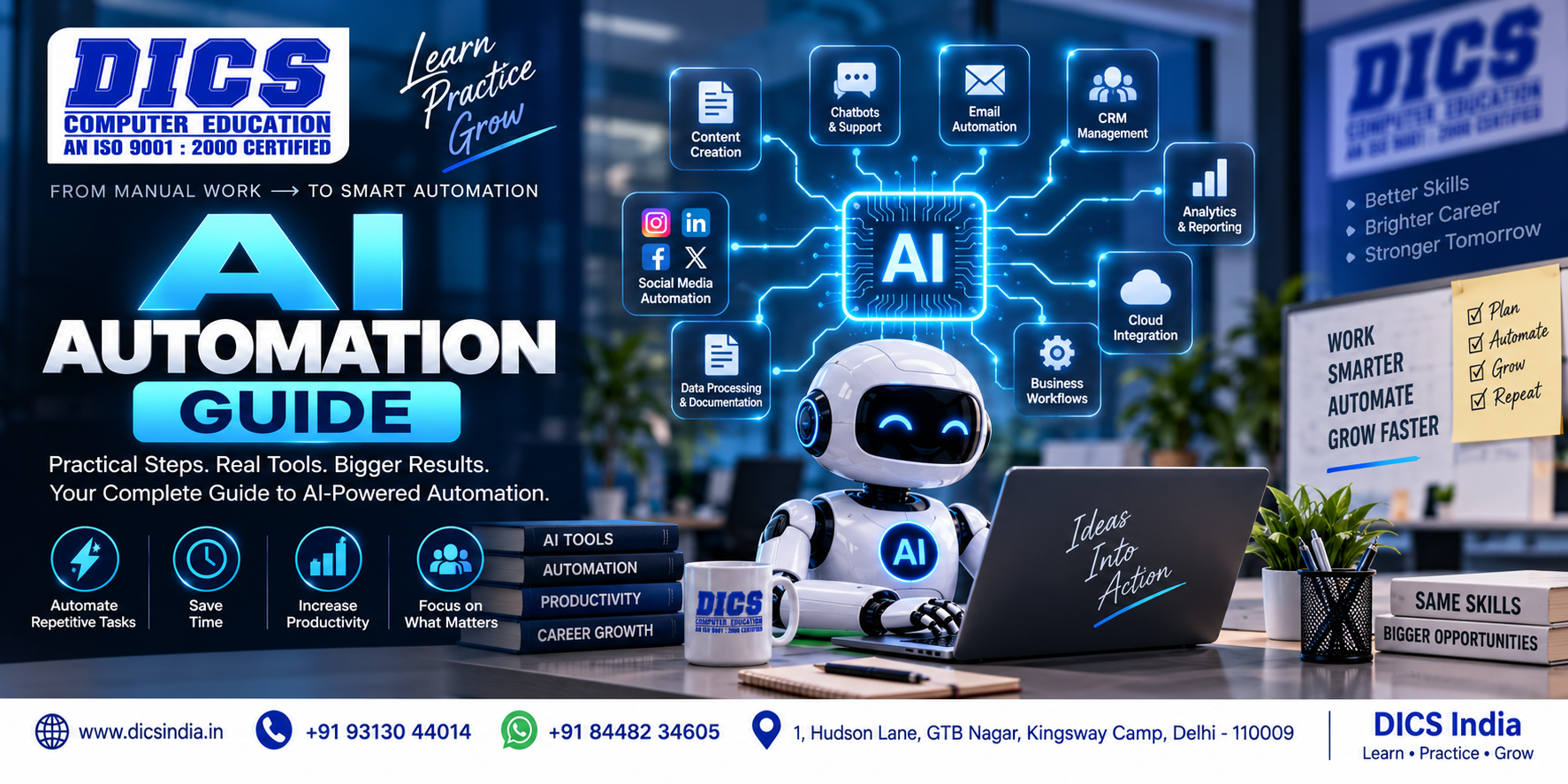
Many people worry that AI will replace digital marketing jobs, but industry analysis indicates a more nuanced reality. AI has automated repetitive tasks like basic copy suggestions, keyword clustering, and simple reporting, but it has also created demand for marketers who know how to use AI tools effectively.

  • Google’s own search quality updates emphasize helpful, people-first content, and they explicitly warn that low-quality, auto-generated pages created just to rank will be hurt High-performing content still needs
  • Subject understanding and real-world experience.
  • Strategic decisions about audience, positioning, and offers.
  • Human judgement for storytelling, empathy, and brand voice.

Industry commentary also highlights that professionals who combine domain expertise with AI-assisted workflows are actually more productive and more valuable, because they can research, test, and optimize faster than before. So rather than eliminating digital marketing careers, AI is raising the bar, rewarding those who learn to work with it instead of competing against it

Advantages of Choosing Digital Marketing as a Career

Digital marketing offers several benefits that make it particularly attractive compared with many traditional career paths in 2026.

Key advantages include:

  • High and growing demand: Digital presence is now essential for almost every type of business, from local stores to global brands, ensuring continuous demand for skilled professionals.
  • Performance-based growth: Rather than waiting for seniority, marketers can grow quickly by demonstrating measurable impact through leads, conversions, and campaign ROI.
  • Flexibility and remote work options: Many digital marketing roles can be performed remotely or in hybrid setups, giving professionals more lifestyle freedom.
  • Low entry barrier in terms of degree: While knowledge is essential, this field does not always require a traditional degree; strong skills, portfolios, and certifications often matter more than formal education.
  • Pathways to freelancing and entrepreneurship: Experienced professionals can transition into consulting, agency ownership, or building their own digital products or brands.

These factors together make digital marketing a future-ready, adaptable career for students, freshers, and working professionals who want to shift into a technology-enabled role.

How to Start a Digital Marketing Career in 2026

ChatGPT isn’t magic. It won’t build your brand for you, and it won’t replace the strategy, relationships, and judgment that great marketing requires.

But it will save you time. It will help you move faster. And in an industry where content demand is relentless and competition is real, that matters more than people give it credit for.

Learn it properly. Use it intentionally. And combine it with skills that actually hold up in the market.

That’s the combination that works in 2026.

Ready to learn digital marketing the right way — with AI tools included?**
DICS India’s Digital Marketing Course covers everything from SEO and paid ads to ChatGPT and live projects, with 100% placement support.

Enroll now at dicsindia.in

Why DICS India Is a Strong Choice for Digital Marketing Training

Choosing the right institute is crucial because it shapes your concepts, confidence, and initial portfolio. Delhi Institute of Computer Science (DICS) has been a recognized name in

IT and computer education for decades, and it offers digital marketing training as part of its industry-oriented course portfolio.

Key reasons to consider DICS India for your digital marketing journey include:

  • Long-standing reputation and experience: DICS has been operating since the early 1990s, making it one of the older and more trusted computer institutes in Delhi   
  •  Multiple branches and strong presence: With numerous branches across Delhi and NCR, DICS has trained thousands of students in different IT and professional courses, including digital marketing.
  • Government and NIELIT-linked recognition (for many IT programs): Several DICS centres are accredited by NIELIT (formerly DOEACC) and recognised for delivering structured, syllabus-based training in computer science and IT subjects, which reflects a focus on quality and standards.
  • Wide technology ecosystem: Beyond digital marketing, DICS offers courses in web development, data analytics, programming, accounting software, graphic design, and more, helping students build complementary skills that improve their employability.
  • Practical and career-focused training approach: Course descriptions emphasise hands-on learning, real-world tasks, and placement assistance, which is critical for learners who want jobs, not just certificates

Because of this combination of experience, recognition, and practical orientation, DICS India is well positioned to help beginners and upskilling professionals build a solid foundation in digital marketing.

Frequently Asked Questions About Digital Marketing Career in India (2026 Guide)

Google's position is that it ranks helpful, accurate content — it doesn't care how it was produced. The issue isn't AI writing, it's low-quality writing. Edit properly, add real value, and you're fine.

Be specific. Give it a role ("you are a digital marketing expert"), a clear task, audience context, and tone instructions. Vague prompts give vague outputs.

The free version works for basic tasks. For consistent professional use — faster responses, better models — ChatGPT Plus ($20/month) is worth it.

It can help plan and draft one. But strategy decisions, audience insights, and platform-specific optimisation still need a human who understands the brand.

Yes, significantly. With AI tools increasingly influencing how people search and discover brands, the goal is shifting from "ranking for clicks" to "being mentioned in AI-generated answers." It's a space that's evolving fast — and marketers who stay ahead of it will have a real edge.

Yes — but learn the basics of digital marketing first. ChatGPT will make a lot more sense, and you'll be able to direct it properly, once you understand what good marketing actually looks like.

Popular digital marketing career options include SEO specialist, PPC expert, social media manager, content strategist, email marketer, and digital marketing manager.

Yes, digital marketing is a high-paying career, especially for professionals with expertise in performance marketing, SEO, and data analytics, as companies focus on ROI-driven strategies.

No, AI will not replace digital marketing jobs but will enhance them. Professionals who learn AI tools and automation will have better opportunities and higher productivity.

Choosing the right institute is important. Institutes like DICS India provide practical training, real-world projects, and industry-focused learning, helping students build job-ready skills.

Get a Free Consultation
Our Course
Share Now

Explore Our Expert-Written Latest Articles to Boost Your Knowledge

Read our expert-written latest articles to stay updated with industry trends, enhance your knowledge, and boost your skills for career growth.

Scroll to Top
Delhi Institute of Computer Science-LOGO
75+

Talk to our Expert

Take the first step towards a smarter Future 🚀

By submitting the form, you agree to our Terms and Conditions and our Privacy Policy.