Tag: DIGITAL MARKETING

  • AI Automation in 2026: Skills, Tools, Careers & How to Start
    AI Automation in 2026: Skills, Tools, Careers & How to Start

    AI Automation in 2026: Skills, Tools, Careers & How to Start

    Written by:

    Artificial intelligence is changing the way people work—but in 2026, simply knowing how to use an AI chatbot is no longer the whole story.

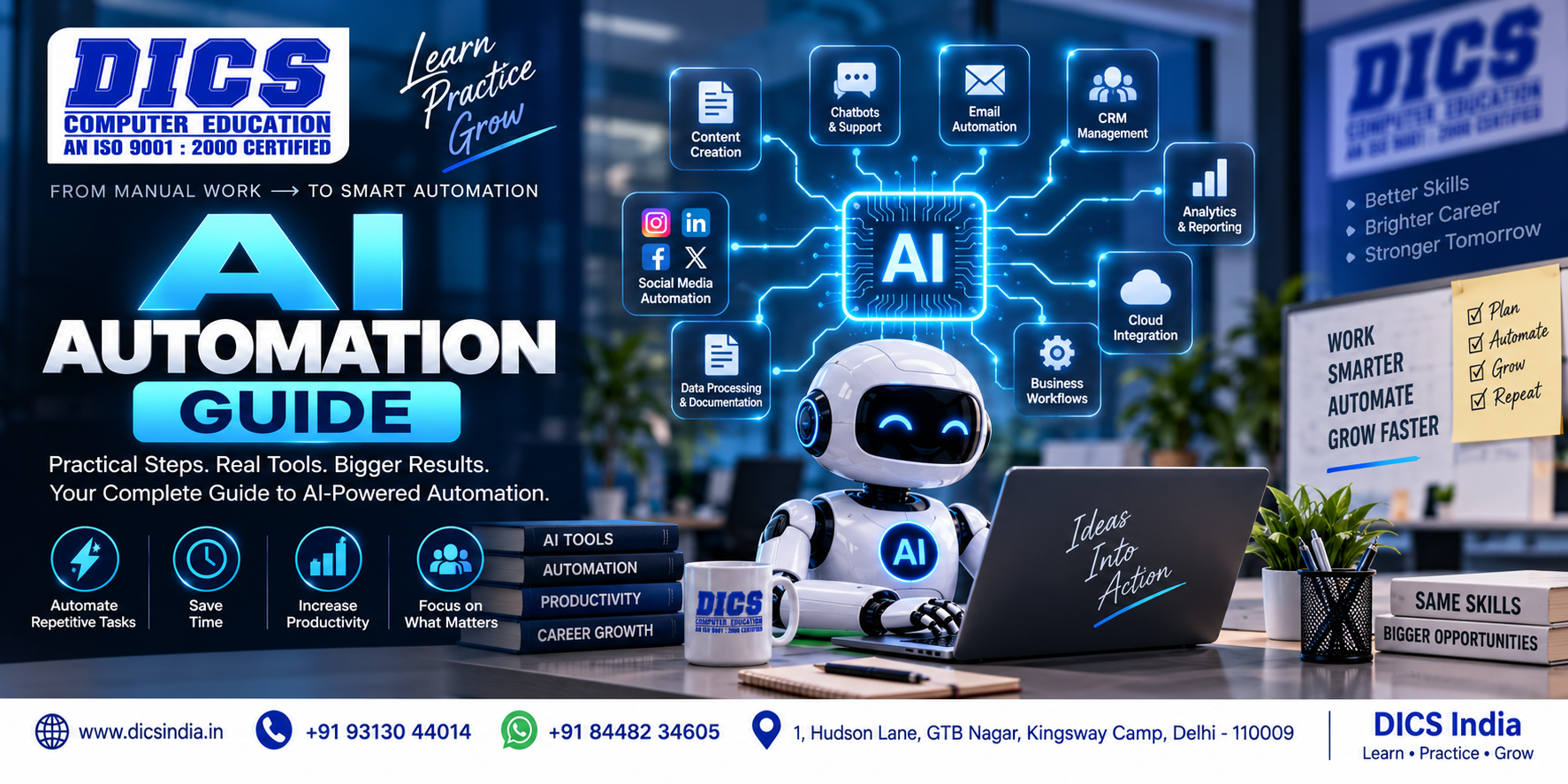
    The bigger opportunity is AI automation: connecting AI with software, data and business processes so that repetitive tasks and workflows can be completed with less manual effort.

    From marketing and sales to customer support, reporting and operations, businesses are exploring ways to integrate AI into everyday workflows.

    That creates a practical question:

    What exactly is AI automation, what skills do you need, and how can a beginner start learning it?

    This guide explains everything from AI workflows and automation tools to career opportunities and a practical learning roadmap.

    Table of Contents

    What Is AI Automation?

    AI automation is the use of artificial intelligence together with automation technologies to perform tasks, process information, generate outputs and manage workflows with limited manual intervention.

    Unlike traditional automation, which usually follows fixed rules, AI automation can work with more variable inputs such as natural language, documents and unstructured information.

    For example:   Traditional automation:  Form submitted → Send email

    AI automation:   Form submitted → AI understands the enquiry → Classifies the lead → Generates a response → Updates CRM → Notifies the sales team

    The goal is not simply to replace people. It is to make workflows faster, more scalable and easier to manage while keeping appropriate human oversight.

    Why Is AI Automation Important in 2026?

    Automation isn’t new. Businesses have been automating emails, spreadsheets, invoices, notifications and data entry for years.

    What’s changing is the type of work that can be included in an automated process. Earlier automation generally worked best when the input was predictable.

    For example: If a customer completes this form, send this email. AI can make the workflow more flexible. A customer might write:

    “Hi, I’m looking for a Python course. I’m a college student and I don’t know whether I should start with Python or data analytics.”

    That isn’t a simple checkbox.

    An AI system can analyse the message, identify the subjects being discussed and route the enquiry accordingly. This doesn’t mean the AI should make every decision by itself.

    In many real-world situations, the better approach is:

    AI handles the repetitive interpretation → automation moves the information → a human handles important decisions.

    That human-AI combination is becoming an important part of workplace discussions. The World Economic Forum has noted that organisations need to redesign work around AI while retaining human oversight, process knowledge and decision-making.   

    Learn Digital Marketing with DICS India

    How Does AI Automation Work?

    A typical AI automation workflow has several parts.

    1. Trigger

    Something starts the process.

    It could be:

    • A website form submission
    • A new email
    • A customer message
    • A new spreadsheet row
    • A payment
    • A calendar event
    • A support ticket
    • A new document

    2. Data

    The system receives information.

    For example:

    Name: Rahul
    Course interest: Python
    Question: “Is it suitable for someone with no programming background?”

    3. AI Processing

    An AI model interprets the information.

    It might determine:

    • The person is a beginner
    • They are interested in Python
    • They need information about eligibility
    • The enquiry should be categorised as a course lead

    4. Automation

    The workflow decides what happens next.

    For example:

    Send the enquiry to the admissions team.

    or:

    Add the lead to the appropriate CRM category.

    5. Final Action

    The workflow completes the task.

    That could mean:

    • Sending an email
    • Updating a spreadsheet
    • Creating a CRM record
    • Generating a report
    • Sending a notification
    • Creating a task for a team member

    This is the basic architecture behind many AI automation systems.

    Kickstart Your Digital Marketing Career Today

    AI Automation vs Traditional Automation

    Traditional Automation AI Automation
    Usually follows fixed rules Can interpret less-structured information
    Works well with predictable inputs Can work with text, documents and natural language
    Uses “If X, then Y” logic AI can analyse information before deciding the next step
    Usually deterministic AI outputs can vary
    Easier to test Requires additional monitoring and validation
    Useful for repetitive processes Useful when understanding information is part of the process
    Take the Next Step Toward a Practical Tech Career
    If learning excites you but direction feels unclear, we can help. Our programs are built to turn curiosity into confidence through hands-on training and real-world guidance.

    Where Can AI Automation Be Used?

    There isn’t one industry called “AI automation.”

    The same basic idea can be applied to many different types of work.

    Marketing

    Marketing teams can use AI automation for tasks such as:

    • Sorting leads
    • Analysing customer messages
    • Creating content drafts
    • Summarising campaign data
    • Generating reports
    • Organising research
    • Monitoring repetitive marketing workflows

    The human marketer still needs to decide what the brand should say and whether the output is actually useful.


    Customer Service

    AI automation can help with:

    • Categorising support requests
    • Finding information
    • Preparing responses
    • Summarising conversations
    • Routing tickets
    • Identifying urgent requests

    For sensitive or complicated situations, human review remains important.


    Sales

    Sales teams can automate parts of:

    • Lead qualification
    • CRM updates
    • Follow-up reminders
    • Meeting summaries
    • Email drafting
    • Customer research

    The objective isn’t simply to send more messages.

    It’s to reduce administrative work so salespeople can spend more time on conversations that actually require them.


    Finance and Accounting

    Automation can assist with repetitive processes such as:

    • Organising financial data
    • Extracting information from documents
    • Categorising transactions
    • Generating reports
    • Sending reminders
    • Processing routine documentation

    Financial workflows require particular care because incorrect information can have real consequences.


    Human Resources

    Possible applications include:

    • Organising applications
    • Scheduling interviews
    • Summarising candidate information
    • Preparing onboarding documents
    • Answering routine employee questions

    Again, automation should not automatically become the final decision-maker for important employment decisions.


    Content Operations

    Content teams can use AI automation to help with:

    • Research organisation
    • Brief creation
    • Content outlines
    • Repurposing material
    • Summarisation
    • Content distribution workflows
    • Performance reporting

    The important word here is help.

    A content workflow still needs editorial judgement.

    What Skills Do You Need for AI Automation?

    This is where beginners sometimes make a mistake. They assume AI automation is mostly about learning tools. It isn’t. Tools change quickly. The underlying skills are more useful.

    1. AI Fundamentals

    Understand what AI models can and cannot do. You should know the difference between:

    • Generative AI
    • Large language models
    • Machine learning
    • AI agents
    • Automation
    • APIs
    • Workflow systems

    You don’t necessarily need advanced mathematics to begin.


    2. Prompting

    If you’re working with language models, you need to know how to give them useful instructions. Good prompting isn’t simply writing long prompts.

    It involves:

    • Providing context
    • Defining the task
    • Giving relevant information
    • Setting constraints
    • Specifying the desired output
    • Checking the result

    3. Workflow Thinking

    This may be the most underrated skill. Before building anything, ask:

    What happens first?

    What information is needed?

    What happens next?

    Where can something go wrong?

    When does a human need to intervene?

    That is process thinking. And it matters more than memorising the buttons inside an automation platform.


    4. APIs and Integrations

    You don’t have to become a full-stack developer to understand APIs. But learning what an API does can make automation much easier to understand. An API essentially allows different software systems to communicate.

    For example:

    Website → API → AI service → CRM

    That simple concept opens up many possibilities.


    5. Data Handling

    Automation is only as good as the information moving through it. You should understand basic concepts such as:

    • Structured data
    • JSON
    • Tables
    • Fields
    • Variables
    • Data validation
    • Duplicates
    • Permissions

    6. Basic Programming

    Coding is not mandatory for every automation project. But basic programming knowledge can become extremely useful when you want to build more advanced workflows. Learning some Python or JavaScript, for example, can help you understand:

    • Variables
    • Conditions
    • Loops
    • APIs
    • Data processing
    • Webhooks

    How DICS Approaches AI Automation Learning

    At DICS, the focus should not be on teaching students a list of trendy AI tools and sending them home with a certificate. AI automation makes more sense when students understand why a workflow exists in the first place. A practical learning approach can include:

    • AI fundamentals
    • Prompting
    • Workflow design
    • Automation concepts
    • AI tools
    • APIs and integrations
    • Data handling
    • Basic programming concepts
    • Practical projects
    • Human review and responsible AI use

    The goal is simple:

    Understand the problem → design the workflow → build it → test it → improve it.

    For students who want structured learning, explore the AI Automation Learning Course at DICS and related AI courses available through the institute.

    Frequently Asked Questions

    AI automation means using AI inside an automated workflow to understand information, generate outputs, classify data or assist with decisions and actions.

    The basics are approachable for beginners. The difficulty increases as workflows become more complex and involve APIs, databases, programming, security and multiple systems.

    No. Many beginner workflows can be created using visual or no-code tools. Coding becomes increasingly useful for advanced customisation and integrations.


    Python is a practical starting point because it is widely used for AI, data processing and API-based applications. JavaScript can also be useful, particularly for web-based systems.

    AI automation can change the tasks people perform and may reduce the need for some repetitive work. At the same time, organisations can create new responsibilities around AI implementation, oversight, data, technology and business processes. The impact varies by industry and role.

    AI provides capabilities such as understanding or generating information. Automation connects steps and makes processes run automatically. AI automation combines the two.

    Yes. Potential applications include lead classification, reporting, research, content workflows, campaign data analysis and repetitive marketing operations. Human review remains important for strategy and quality.

    Get a Free Consultation
    Our Course
    Share Now

    Explore Our Expert-Written Latest Articles to Boost Your Knowledge

    Read our expert-written latest articles to stay updated with industry trends, enhance your knowledge, and boost your skills for career growth.

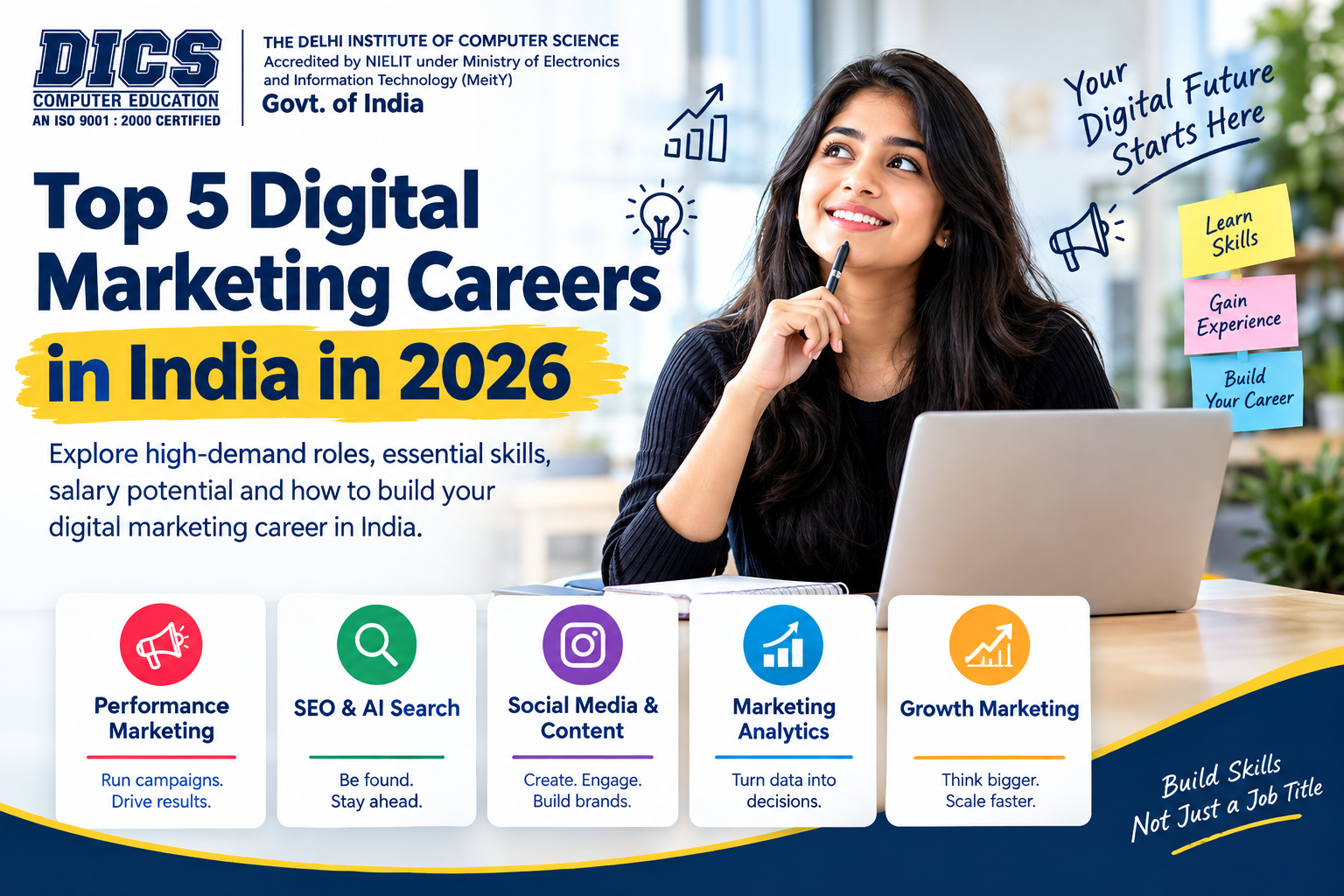
  • TOP 5 CAREERS IN DIGITAL MARKETING IN INDIA 2026

    TOP 5 CAREERS IN DIGITAL MARKETING IN INDIA 2026

    TOP 5 CAREERS IN DIGITAL MARKETING IN INDIA 2026

    Written by:

    Digital marketing has become one of the most exciting career fields in India. From startups and e-commerce companies to educational institutions, real estate businesses, healthcare brands and established enterprises, businesses are investing heavily in digital channels to find customers and grow their brands.

    And here’s what makes 2026 particularly interesting: digital marketing is no longer just about social media posting or writing blogs.

    AI is changing how marketers research audiences, create content, analyse campaigns, automate repetitive tasks and understand customer behaviour. At the same time, businesses still need people who understand marketing fundamentals and can turn technology into measurable results.

    This has opened up several career paths for students, graduates, working professionals and people looking to switch careers.

    If you’re researching digital marketing careers India, you might be wondering:

    • Is digital marketing a good career in 2026?
    • Which digital marketing jobs are in demand?
    • What skills should I learn?
    • Can freshers get digital marketing jobs?
    • What is the salary potential?
    • How is AI changing digital marketing careers?

    In this guide, we’ll explore the top 5 digital marketing career opportunities in India in 2026, the skills required for each role, who should consider them and how you can start building a career in this rapidly changing industry.

    Table of Contents

    1. Performance Marketing Specialist

    If you enjoy numbers, advertising, experimentation and measurable results, performance marketing could be one of the best career options for you.

    Performance marketing is focused on achieving specific business outcomes through paid digital campaigns. Instead of simply asking how many people saw an advertisement, performance marketers focus on questions such as:

    How many leads did we generate?

    How much did each lead cost?

    Which campaign generated the most sales?

    What was our return on advertising spend?

    Performance marketers commonly work with platforms such as Google Ads, Meta Ads and YouTube Ads. They research keywords and audiences, create campaigns, test advertisements, monitor performance and optimise budgets.

    What does a performance marketer do?

    A performance marketing professional may be responsible for:

    • Google Ads campaign management
    • Meta Ads campaign management
    • Keyword research
    • Audience research
    • Ad copywriting
    • Creative testing
    • Conversion tracking
    • Landing-page optimisation
    • A/B testing
    • Budget management
    • Campaign reporting
    • ROI and ROAS analysis

    For example, imagine an education company wants to generate enquiries for a digital marketing course in Delhi.

    A performance marketer could target users searching for terms related to digital marketing courses, create relevant advertisements, send users to a conversion-focused landing page and track how many enquiries are generated.

    The marketer can then analyse which keywords and advertisements are producing quality leads and move the budget toward better-performing campaigns.

    That’s why performance marketing requires more than knowing how to click buttons inside an advertising platform.

    You need to understand customers, competition, numbers, creative strategy and conversion psychology.

    Skills required for performance marketing

    If you want to pursue this career, consider learning:

    • Google Ads
    • Meta Ads
    • YouTube advertising
    • Keyword research
    • Conversion tracking
    • Google Analytics 4
    • Landing-page optimisation
    • Copywriting
    • Excel
    • Data analysis
    • A/B testing
    • AI-assisted marketing

    AI can also help performance marketers with research, creative variations, data analysis and reporting. However, the marketer still needs to understand the business objective and make strategic decisions.

    Who should choose performance marketing?

    Performance marketing may suit you if you:

    • Enjoy numbers and analytics
    • Like experimentation
    • Want measurable results
    • Are interested in business
    • Enjoy advertising
    • Like solving problems

    A possible career progression could look like:

    Digital Marketing Intern → PPC Executive → Performance Marketing Specialist → Performance Marketing Manager → Growth Marketer → Consultant

    2. SEO & AI Search Specialist

    Search engine optimisation remains an important digital marketing career path, but SEO in 2026 is much broader than traditional keyword optimisation.

    Search behaviour is changing rapidly. Users can discover businesses and information through traditional search engines, local search, social platforms and AI-powered search experiences.

    As a result, modern SEO professionals need to understand not only how websites rank but also how information is discovered, interpreted and presented across different search environments.

    This has created opportunities in areas such as:

    • Technical SEO
    • On-page SEO
    • Local SEO
    • E-commerce SEO
    • Content SEO
    • International SEO
    • AEO
    • GEO
    • AI-assisted SEO
    What does an SEO specialist do?

    An SEO professional may work on:

    • Keyword research
    • Search-intent analysis
    • Competitor research
    • Technical SEO audits
    • On-page optimisation
    • Internal linking
    • Content strategy
    • Local SEO
    • Google Business Profile optimisation
    • Schema markup
    • Search Console analysis
    • Website performance
    • Link-building strategies
    • AI-search visibility

    For example, suppose someone searches:

    “Best digital marketing institute in Delhi.”

    An SEO professional shouldn’t simply repeat that keyword throughout a page.

    They need to understand what the searcher actually wants.

    Are they looking for course information?

    Fees?

    Reviews?

    Placement assistance?

    Location?

    Course duration?

    Career opportunities?

    The better an SEO professional understands search intent, the better they can create content and website experiences that genuinely answer the user’s needs.

    SEO and AI in 2026

    AI has made content production much faster.

    But faster content production doesn’t automatically mean better SEO.

    When anyone can generate thousands of words quickly, valuable SEO professionals become the people who can provide:

    • Original insights
    • Accurate information
    • First-hand experience
    • Strong content structure
    • Search-intent understanding
    • Technical expertise
    • Useful examples
    • Genuine expertise

    AI can assist with repetitive SEO tasks, but strategic thinking remains extremely important.

    Skills required for an SEO career

    You should consider learning:

    • Google Search Console
    • Google Analytics 4
    • Keyword research
    • Technical SEO
    • On-page SEO
    • Local SEO
    • Content strategy
    • Internal linking
    • Schema
    • Basic HTML
    • Competitor analysis
    • AI-assisted SEO
    • AEO
    • GEO
    • Excel and data analysis
    Who should choose SEO?

    SEO is a good option if you enjoy:

    • Research
    • Websites
    • Writing
    • Data
    • Problem-solving
    • Competitor analysis
    • Long-term strategy

    A typical career progression can be:

    SEO Intern → SEO Executive → SEO Specialist → SEO Manager → SEO Consultant → SEO Strategist

    Learn Digital Marketing with DICS India

    3. Social Media & Content Strategist

    If you are creative, understand social media trends and enjoy creating content, social media marketing could be a strong career option.

    But modern social media marketing is much more than publishing posts.

    A professional social media strategist needs to understand:

    Content + Audience + Platform + Branding + Analytics + Conversion

    A company might have thousands of followers but very few enquiries. Another business may have a smaller audience but generate significantly more customers.

    The difference often comes down to strategy.

    What does a social media professional do?

    Depending on the company, responsibilities can include:

    • Social media strategy
    • Instagram management
    • Facebook marketing
    • LinkedIn marketing
    • YouTube strategy
    • Short-form video
    • Reel concepts
    • Copywriting
    • Content calendars
    • Community management
    • Influencer marketing
    • Trend research
    • Social analytics
    • Paid social campaigns

    One of the most valuable skills in 2026 is understanding how to create content that earns attention quickly.

    For example, instead of starting a Reel with:

    “Today we’re going to discuss digital marketing.”

    a marketer might begin with:

    “Still looking for a career that can grow with AI?”

    The second opening creates curiosity and gives the viewer a reason to continue watching.

    AI and social media marketing

    AI can help social media professionals with:

    • Content ideas
    • Reel scripts
    • Caption drafts
    • Content calendars
    • Audience research
    • Content repurposing
    • Creative variations
    • Campaign analysis
    • Research and brainstorming

    But successful social media marketing still requires creativity.

    AI can help produce content faster. It doesn’t automatically know what will make a particular audience stop scrolling.

    That’s where human understanding of culture, emotion, storytelling and audience psychology becomes important.

    Skills required

    Consider learning:

    • Social media strategy
    • Copywriting
    • Short-form video
    • Content marketing
    • Canva or graphic design fundamentals
    • Video editing basics
    • Social analytics
    • Influencer marketing
    • Meta Ads
    • AI content tools
    • Branding
    Who should choose social media marketing?

    This career could be right for you if you’re:

    • Creative
    • Comfortable with communication
    • Interested in trends
    • Good at storytelling
    • Interested in video
    • Curious about audience behaviour

    A possible career path is:

    Social Media Intern → Social Media Executive → Social Media Specialist → Social Media Manager → Content Strategist → Brand/Social Media Consultant

    Kickstart Your Digital Marketing Career Today

    4. Marketing Analytics & AI Marketing Specialist

    One of the most valuable combinations emerging in modern marketing is:

    Marketing + Data + AI

    Businesses don’t just want to know how many people visited their website.

    They want to know:

    Where did those visitors come from?

    Which campaign generated the lead?

    Which channel generated the highest-quality customers?

    How much did it cost to acquire each customer?

    Where are potential customers dropping out of the conversion process?

    This is where marketing analytics becomes extremely valuable.

    What does a marketing analytics professional do?

    Depending on the organisation, the role can involve:

    • Website analytics
    • Campaign reporting
    • Conversion analysis
    • Customer segmentation
    • Dashboard creation
    • Marketing attribution
    • Data visualisation
    • Campaign performance analysis
    • CRM analysis
    • Marketing automation

    Tools commonly used in this area include:

    • Google Analytics 4
    • Google Search Console
    • Looker Studio
    • Excel
    • SQL
    • CRM platforms
    • Advertising dashboards
    • AI tools

    Imagine an education company receives 1,000 leads.

    Simply knowing that there are 1,000 leads isn’t enough.

    An analyst might discover that:

    • Search generated fewer leads but higher-quality enquiries.
    • Social media generated more leads but lower conversion rates.
    • One campaign generated the highest revenue.
    • A particular landing page had a significantly better conversion rate.

    These insights allow businesses to make better marketing decisions.

    How AI is changing marketing analytics

    AI is increasingly becoming part of the marketing workflow.

    It can assist with:

    • Data analysis
    • Reporting
    • Pattern identification
    • Customer segmentation
    • Campaign insights
    • Content personalisation
    • Forecasting
    • Automation
    • Research

    The important skill isn’t simply knowing how to use an AI tool.

    It’s understanding what question you need the data to answer.

    Who should choose marketing analytics?

    This career is particularly suitable if you enjoy:

    • Numbers
    • Technology
    • Excel
    • Data
    • Logical thinking
    • Problem-solving
    • Business strategy

    A possible progression is:

    Marketing Analyst → Digital Marketing Analyst → Marketing Analytics Specialist → Growth Analyst → Marketing Manager → Growth Strategist

    Take the Next Step Toward a Practical Tech Career
    If learning excites you but direction feels unclear, we can help. Our programs are built to turn curiosity into confidence through hands-on training and real-world guidance.

    5. Digital Marketing Consultant & Growth Marketer

    After gaining experience across different digital channels, some professionals move toward growth marketing and consulting.

    This is where digital marketing becomes much more business-focused.

    Instead of looking only at SEO, advertising or social media, growth marketers examine the entire customer journey.

    Think about:

    Traffic → Engagement → Lead → Conversion → Customer → Retention

    A company might have excellent website traffic but poor conversion rates.

    Another company might generate thousands of leads but struggle to convert those leads into customers.

    A growth marketer looks for the bottleneck.

    What does a growth marketer work on?

    Depending on the organisation, responsibilities may include:

    • SEO
    • Performance marketing
    • Content
    • Social media
    • Email marketing
    • CRM
    • Conversion optimisation
    • Landing pages
    • Analytics
    • Marketing automation
    • Customer retention
    • AI workflows

    The role requires a broader understanding of marketing than a single-channel specialist.

    Why consulting can be attractive

    Once you have strong skills and experience, you may choose to work independently.

    You could provide services to:

    • Startups
    • E-commerce brands
    • Educational institutions
    • Real estate businesses
    • Local businesses
    • D2C companies
    • Professional service businesses

    You can work as a freelancer, consultant or eventually build your own digital marketing agency.

    However, successful consulting requires more than technical knowledge.

    Clients want business outcomes.

    They want to know:

    How many qualified leads did you generate?

    Did sales improve?

    Did customer acquisition costs decrease?

    Did organic traffic grow?

    Did conversions improve?

    That’s why building a portfolio of real projects and case studies is so valuable.

    Which Digital Marketing Career Is Right for You?

    Career PathBest Suited ForImportant Skills
    Performance MarketingAnalytical thinkersGoogle Ads, Meta Ads, Analytics
    SEO & AI SearchResearchers and problem-solversSEO, Content, Technical SEO, AI Search
    SocialMedia& ContentCreative peopleContent Creation, Video, Communication
    Marketing AnalyticsData-oriented peopleGA4, Excel, SQL, AI & Data Analysis
    Growth MarketingStrategic thinkersFull-Funnel Marketing, Analytics, CRO

    How to Start a Digital Marketing Career in India

    You don’t need to wait until you know everything before starting.

    Follow a practical learning path.

    Step 1: Understand digital marketing fundamentals

    Learn how customers move from awareness to consideration and finally to conversion.

    Understand the role of SEO, advertising, content, social media and analytics.

    Step 2: Choose a specialisation

    Start with one core area.

    For example:

    SEO + AI or Google Ads + Meta Ads or Social Media + Content or Analytics + AI

    Once you have a foundation, add complementary skills.

    Step 3: Work on real projects

    Theory alone isn’t enough.

    Create practical projects for a website, local business, personal brand, e-commerce concept or educational project.

    Track what you do.

    Step 4: Build a portfolio

    Your portfolio could include:

    • SEO audits
    • Keyword research
    • Website optimisation
    • Google Ads campaigns
    • Meta Ads campaigns
    • Content calendars
    • Social media campaigns
    • Analytics dashboards
    • Landing pages
    • Case studies

    Step 5: Apply for internships and entry-level positions

    Don’t wait for the perfect job.

    A good internship can give you exposure to:

    • Real clients
    • Campaigns
    • Budgets
    • Reporting
    • Teamwork
    • Deadlines

    Step 6: Keep upgrading your skills

    Digital marketing changes continuously.

    Platforms change.

    Algorithms change.

    AI changes workflows.

    Consumer behaviour changes.

    The professionals who continue learning are better positioned to adapt.

    Frequently Asked Questions

    Yes. Digital marketing offers career opportunities across SEO, paid advertising, social media, analytics, content, e-commerce and AI-powered marketing. The field is also evolving quickly, creating opportunities for professionals who continuously upgrade their skills.

    Yes. Freshers can enter the industry through internships and junior positions. A strong portfolio, practical projects and relevant skills can help demonstrate your capabilities to employers.

    There isn’t one answer for everyone. Performance marketing, SEO, social media, analytics and growth marketing all offer different career paths. Your choice should depend on your interests, strengths and long-term goals.

    Yes. Students can start learning digital marketing while studying and build practical projects before graduation. Developing a portfolio can help them demonstrate their skills when applying for internships and entry-level jobs.

    A degree can be useful, but digital marketing also requires practical skills. Employers may consider experience, portfolio projects, certifications and demonstrated results alongside educational qualifications.


    AI is changing digital marketing, but marketing still requires strategy, creativity, communication, customer understanding and decision-making. Professionals who learn how to use AI effectively may be better positioned to work alongside these technologies.


    Yes. After developing sufficient skills and experience, professionals can offer services such as SEO, paid advertising, social media management, content marketing and analytics as freelancers or consultants.

    Get a Free Consultation
    Our Course
    Share Now

    Explore Our Expert-Written Latest Articles to Boost Your Knowledge

    Read our expert-written latest articles to stay updated with industry trends, enhance your knowledge, and boost your skills for career growth.

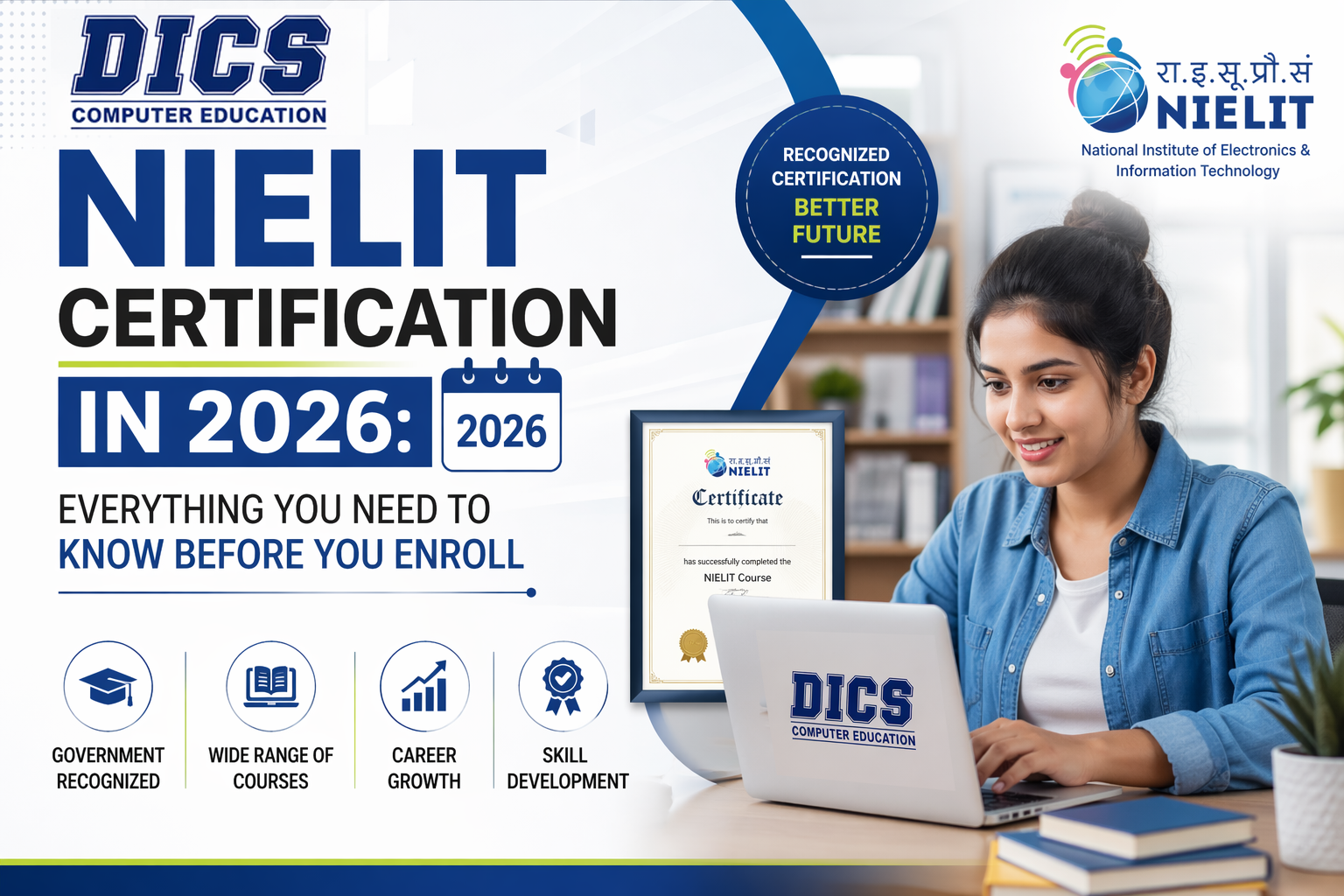
  • NIELIT Certification in 2026: Everything You Need to Know Before You Enroll

    NIELIT Certification in 2026: Everything You Need to Know Before You Enroll

    NIELIT Certification in 2026: Everything You Need to Know Before You Enroll

    Written by:

     Most students in Delhi hear “NIELIT,” they either think it’s just that CCC certificate their college made them get, or they have no idea what it is at all. Both of those takes are missing the bigger picture. NIELIT is one of the most underrated government bodies in India when it comes to IT education, and in 2026, its certifications are more relevant than they’ve ever been.

    Whether you just finished Class 12, you’re a graduate looking to enter the IT sector, or you’re a working professional who needs that government-recognized qualification on your resume — this guide covers everything: what NIELIT actually is, which course is right for you, the latest 2026 exam updates, and why enrolling through an accredited institute makes a real difference.

    Table of Contents

    What Is NIELIT? (And Why It’s More Important Than You Think)

    NIELIT stands for the National Institute of Electronics and Information Technology. It operates under the Ministry of Electronics and Information Technology (MeitY), Government of India, and has been functioning since the early 1990s — earlier as the DOEACC Society before being rechristened NIELIT.

    Here’s what makes it different from a typical private certification body: NIELIT is a Deemed-to-be University recognized under the Distinct Category. Its certifications are accepted by government departments, public sector undertakings (PSUs), state public service commissions, and recognized by bodies like AICTE and UGC. That’s not something a private IT training certificate can offer you.

    Think of NIELIT as the bridge between informal IT skills and formal, government-recognized qualifications — especially important in a job market where employers and government recruiters look for verified credentials.

    The Two Worlds of NIELIT: IT Courses vs. Digital Literacy Courses

    NIELIT’s offerings broadly split into two categories, and understanding this split is the first step to figuring out which path makes sense for you.

    1. Digital Literacy Courses (DLC)

    These are foundational programs designed for basic computer literacy. The most well-known ones are:

    • CCC – Course on Computer Concepts (80 hours)
    • BCC – Basic Computer Course
    • ACC – Advanced Course on Computers
    • ECC – Extended Course on Computers

    CCC is the heavyweight here. It’s the certificate that most government recruitment notifications in India (SSC, state PSCs, railway jobs, clerical posts) explicitly list as a mandatory computer proficiency requirement. If you’re aiming for any Group C government job, a CCC is practically non-negotiable.

    The eligibility is simple — anyone who has passed Class 10 can appear directly. No upper age limit, no complicated pre-requisites. That’s by design; these programs exist specifically to build digital literacy at scale across India.

    2. IT Courses: The O / A / B / C Level Framework

    This is where things get more structured — and significantly more career-defining. NIELIT’s four-level IT programme is a ladder system:

    O Level (Ordinary Level)
    Think of this as a 1-year IT diploma equivalent. It covers programming fundamentals, web design, databases, IT tools, and emerging technologies. Eligibility: 10th Pass (Class X) or an ITI certificate holder. Exams are conducted in online mode.

    A Level (Advanced Level)
    Equivalent to an Advanced Diploma in IT. Covers programming in Java, Python, databases, operating systems, artificial intelligence, and more. Designed for graduates or O Level passouts. This is the sweet spot for anyone targeting IT roles in the government sector or looking to formalize their tech skills.

    B Level (MCA Level)
    Equivalent to an MCA-level qualification. This is a serious, multi-year programme for professionals who want deep technical grounding. Not a casual undertaking.

    C Level (M. Tech Level)
    The top of the NIELIT IT ladder. Equivalent to an M.Tech in Computer Science. Very few institutions offer guidance at this level.

    For most students reading this — 12th pass, undergraduates, or early-career professionals in Delhi-NCR — O Level and A Level are the most practical and impactful choices.

    Learn Digital Marketing with DICS India

    Why NIELIT Certification Actually Matters in 2026

    : NIELIT certifications are backed by the Government of India. When you apply for a government job and the notification says “Computer Certificate from a recognized institution required,” a Coursera badge doesn’t count. A NIELIT certificate does.

    Beyond government jobs, there are practical career reasons to consider:

    • NIELIT certificates are accepted as educational qualifications in many state and central government recruitment drives.
    • The O Level certificate is treated as equivalent to a Foundation Level Degree in IT — relevant for both job applications and further study.
    • Employers in the private sector, particularly for IT support, data entry, software junior roles, and BPO operations, recognize NIELIT credentials as a baseline qualification.
    • Several state PSCs explicitly accept NIELIT O Level as proof of computer proficiency for promotions within government departments.
    Kickstart Your Digital Marketing Career Today

    Direct Enrollment vs. Enrolling Through an Accredited Institute — What’s the Smarter Choice?

    You have two ways to register for NIELIT exams:

    Direct Registration: You register yourself on the NIELIT student portal without any institutional support. You’re responsible for your own preparation, project submissions, and tracking deadlines.

    Through a NIELIT-Accredited Institute: You enroll through a recognized center, which handles your registration, provides classroom or guided training, helps with practical components, and keeps you updated on exam cycles and documentation requirements.

    Here’s my honest take: For CCC, direct registration works fine if you’re disciplined and have the time to self-study. For O Level and above, the guided route is almost always better — not because you can’t do it solo, but because the course involves modules, practicals, project submissions, and structured preparation across multiple exam sittings. Having an institute to guide you through that process reduces the margin for error significantly.

    Take the Next Step Toward a Practical Tech Career
    If learning excites you but direction feels unclear, we can help. Our programs are built to turn curiosity into confidence through hands-on training and real-world guidance.

    Why DICS India Is the Best NIELIT Training Centre in Delhi-NCR

    there’s no shortage of institutes in Delhi that claim to offer NIELIT courses. Walk into any market in Laxmi Nagar, Rohini, or Dwarka and you’ll find printed banners with “NIELIT CCC / O Level — Enroll Now” plastered on every other shop. So the real question isn’t where can I find a NIELIT centre — it’s which one is actually worth your time?

    1. 30+ Years of Legitimate History — Not a Fly-by-Night Setup

    DICS India (Delhi Institute of Computer Science) was established when most of today’s “digital institutes” didn’t even exist. Since the early 1990s, the institute has been actively contributing to IT education in Delhi-NCR — which means it has been through every wave of technology change, every NIELIT syllabus revision, and every shift in government recruitment requirements.

    That kind of longevity isn’t just a marketing number. It means the institute has genuinely battle-tested systems — for admissions, training, exam registration, and student support. When NIELIT changes its exam pattern or updates the syllabus (which it does), DICS India’s faculty doesn’t scramble to figure it out. They’ve seen it before.

    For a student enrolling in a government-recognized certification, this institutional stability is not a small thing.


    2. Official NIELIT Accreditation — Verified and Active

    DICS India holds active NIELIT accreditation, which means your enrollment is officially registered in NIELIT’s system. This is crucial and honestly, something many students don’t verify before paying fees at random institutes.

    Here’s what that accreditation means for you practically:

    • Your name gets submitted to NIELIT through a recognized channel — no errors, no rejections due to unregistered institutes
    • Your certificate is fully traceable and verifiable on the official NIELIT student portal
    • The institute undergoes periodic checks by NIELIT to maintain accreditation — so quality isn’t left to chance
    • Employers and government departments can verify your qualification directly — no questions raised, no doubts

    If an institute doesn’t have active NIELIT accreditation and you enroll there for an O Level or CCC course, you’re essentially studying with no official path to a valid certificate. Always verify. DICS India’s accreditation is the real deal.


    3. Faculty That Actually Knows the NIELIT Exam Pattern

    This sounds obvious, but it isn’t. A lot of institutes hire generic computer trainers who teach MS Office and call it “NIELIT preparation.” The NIELIT O Level, in particular, has a very specific exam structure — four theory modules (M1, M2, M3, M4), a practical component, and a project submission — all of which need focused preparation.

    At DICS India, the faculty is trained specifically around NIELIT’s curriculum and exam format. That means:

    • Module-wise coverage, not random topic-hopping
    • Practice sets aligned with Part A (objective) and Part B (subjective) question formats
    • Guidance on the practical examination and project — areas where self-studying students typically struggle the most
    • Regular mock tests to track progress before the actual exam cycle

    Students who have gone through proper NIELIT-specific coaching vs. those who crammed on their own will tell you — the difference shows up in the result, and more importantly, in the grade.


    4. Multiple Branches Across Delhi-NCR — Convenience That Actually Matters

    DICS India operates across multiple branches in Delhi-NCR, including areas across West Delhi, North Delhi, and surrounding regions. This isn’t just a convenience point — it’s a real factor in whether a student can consistently attend classes or not.

    Anyone who has studied in Delhi knows: a 45-minute commute each way for a certification course is exhausting and eventually becomes the reason students drop off. Having a branch near your home or college means you actually show up, complete the course, and clear the exam.

    If you’re in Dwarka, Janakpuri, Rohini, Pitampura, or other parts of West and North Delhi, there’s a DICS India centre accessible to you. Reach out to confirm the nearest location for your specific area.


    5. End-to-End Student Support — From Enrollment to E-Certificate

    This is genuinely one of the most underrated things about choosing an established institute for NIELIT. The process of getting a NIELIT certification isn’t just “attend class and appear for exam.” There’s:

    • OEAF (Online Examination Application Form) submission — with strict deadlines
    • Fee payment on the NIELIT portal
    • Admit card download and verification
    • Appearing for theory + practical exams at designated centres
    • Result tracking and e-certificate download from student.nielit.gov.in

    Miss any one of these steps or make an error in the application, and you could lose an entire exam cycle — which means waiting another 6 months for the next opportunity.

    DICS India’s team guides students through every single step of this process. You’re not figuring out government portals alone. That support has real value, especially for students who are doing this for the first time.


    6. More Than Just NIELIT — A Full IT Career Launchpad

    One thing that separates DICS India from pure “exam prep” institutes is the breadth of what it offers alongside NIELIT certifications. DICS India is not a one-trick shop that only pushes CCC enrollments.

    Students here also have access to:

    • Full Stack Web Development training
    • Digital Marketing and Social Media courses
    • Graphic Design and Multimedia programs
    • Tally, Accounting, and GST certification
    • Advanced MS Office and computer application courses

    What this means practically: once you clear your NIELIT O Level or CCC, you don’t have to look elsewhere for the next step in your IT education. You’re already in an ecosystem that can take you further — into a marketable skill, a job-ready portfolio, or a professional certification.

    For a student in Delhi who’s thinking about their career trajectory beyond just “passing the government exam,” this matters a lot.


    7. A Track Record of Student Success Across Delhi-NCR

    Over three decades, DICS India has trained thousands of students across its Delhi-NCR branches. Many of them are now working in government departments, private companies, and IT roles — with their NIELIT certifications as one of the first qualifications that got them through the door.

    That’s not something you build by running a shoddy operation. Consistent results, consistent teaching quality, and consistent support — over 30 years — is the only way that kind of track record gets built.

    When you enroll at DICS India for your NIELIT course, you’re not a test case. You’re joining a system that already works.

    DICS India vs. Random Local Institute

    FactorDICS IndiaGeneric Local Centre
    NIELIT Accreditation Active & verified Often expired or unverified
    Years of Operation30+ yearsUsually 2–5 years
    Faculty TrainingNIELIT-specific exam prepGeneric computer trainer
    Exam Registration Help Full guidance Self-manage
    Multiple Branches Delhi-NCR coverageSingle location usually
    Courses Beyond NIELIT Full IT curriculumLimited to basic courses
    Student Support Post-Exam Result, e-cert, next steps Usually none

    Learning the Right Way

    To actually succeed, you need practical learning, real projects, and guidance.This is why structured training can make a big difference, especially for beginners.You don’t need multiple skills. You need one  strong skill, consistent effort, and practical execution.If you stay consistent and use AI effectively, you can build a high-income career in a relatively short time.

    Frequently Asked Questions

    Yes. NIELIT is an Autonomous Scientific Society under the administrative control of MeitY, Government of India.

    There is no limit. You can appear as many times as you want to improve your grade.


    It is treated as equivalent to a Foundation Level IT Degree and recognized by AICTE, UGC, and several state PSCs.


    Yes, for CCC and O Level, direct registration on student.nielit.gov.in is possible. However, for structured preparation and practical training, an accredited institute is recommended.

    Official results are published at student.nielit.gov.in. The O/A/B/C Level January 2026 results are expected around April 24, 2026.


    Yes. DICS India is an active NIELIT-accredited training centre with multiple branches across Delhi-NCR. It offers CCC, O Level, and other NIELIT certifications with dedicated batches, faculty trained on NIELIT exam patterns, and full end-to-end student support from enrollment to e-certificate download.


    DICS India has 30+ years of experience in IT education, holds active NIELIT accreditation, provides faculty specifically trained for NIELIT exam preparation, helps students with OEAF registration and exam logistics, and offers a full IT course ecosystem beyond just NIELIT — all under one roof across multiple Delhi-NCR locations.

    You can check the accreditation status of any institute on the official NIELIT website (nielit.gov.in) under the facilitation centre section. Always verify before enrolling — expired or unverified accreditation means your certificate may not be valid.

    Most people fail due to lack of practice, inconsistency, too much theory, and frequently switching between skills instead of focusing on one.

    Get a Free Consultation
    Our Course
    Share Now

    Explore Our Expert-Written Latest Articles to Boost Your Knowledge

    Read our expert-written latest articles to stay updated with industry trends, enhance your knowledge, and boost your skills for career growth.

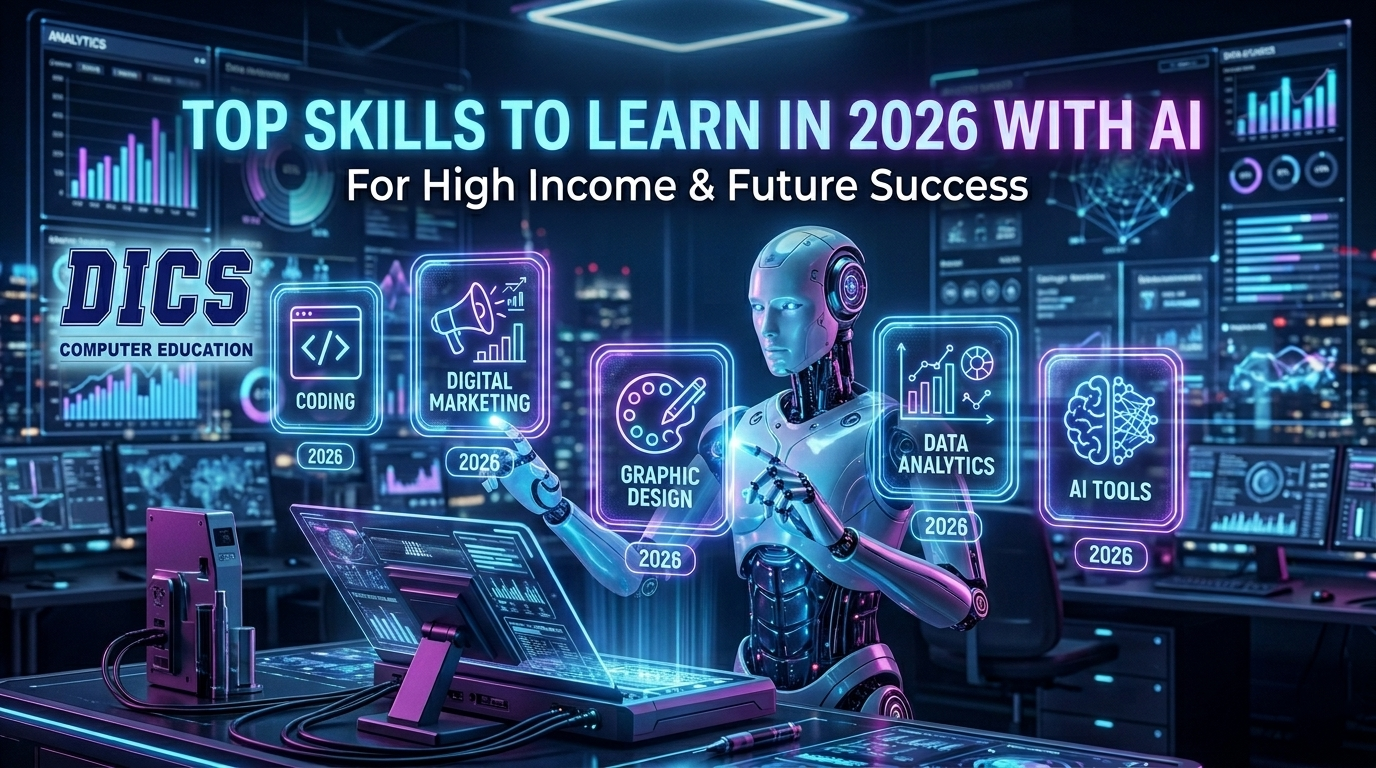
  • Best Skills to Learn in 2026 with AI for High Income

    Best Skills to Learn in 2026 with AI for High Income

    Best Skills to Learn in 2026 with AI for High Income

    Written by:

    If you’ve been thinking about your career lately — maybe feeling confused, stuck, or unsure about what to do next — you’re not alone. A lot of people today are putting in effort but not getting the kind of results they expected.

    The real issue is not lack of effort. It’s direction. In 2026, success is no longer about how much you study — it’s about what you can actually do and how valuable that is in the real world.

    And there’s one more important shift: AI is now part of almost every skill that actually pays. So if you ignore AI, you’re already behind. learn the best skills to learn in 2026 with AI 

    Table of Contents

    What Are High-Income Skills to learn in 2026 with AI?

    High-income skills are practical abilities that help you earn money by solving real-world problems.

    • They help businesses grow
    • They are in high demand
    • They can generate ₹30K–₹1L+ per month

    Unlike traditional degrees, these skills are result-oriented. You get paid for what you can do, not what you have studied.

    Why AI Is Now Essential ?

     AI is not replacing jobs — people who use AI are replacing those who don’t. This is the biggest shift happening right now.

    AI helps you work faster, smarter, and more efficiently. Whether it’s marketing, coding, design, or analytics — AI enhances everything.

    Learn Digital Marketing with DICS India

    Can ChatGPT Replace a Digital Marketer?

    people who use AI well are starting to outperform people who don’t. Not because AI is smarter — but because they’re moving faster, producing more, and spending their mental energy on strategy instead of first drafts.

    There are things ChatGPT flat-out cannot do. It can’t build real relationships with your audience. It doesn’t understand your business the way you do. It can’t make judgment calls about what a client really needs, or read the room in a campaign that’s going sideways. It also gets things wrong — including facts — so you always need to verify anything data-specific.

    ChatGPT handles the work that slows you down. You handle the thinking that actually matters.

    Kickstart Your Digital Marketing Career Today

    Top Skills to Learn in 2026

    Digital Marketing (With AI)

    Digital marketing is one of the fastest ways to start earning because every business needs visibility and customers.You learn SEO, social media marketing, paid ads, and content strategy.AI helps in keyword research, content creation, and campaign optimization.This skill is beginner-friendly and has strong freelancing and job opportunities.

    Data Analytics (With AI)

    If you enjoy working with data and logic, this is a great option.You learn Excel, Power BI, and data visualization.AI helps analyze patterns and speed up reporting.It’s a strong career path with high demand in corporate roles.

    Web Development (With AI Support)

    Web development is a future-proof skill. Every business needs a website.You learn HTML, CSS, JavaScript, and basic backend concepts.AI helps with coding, debugging, and faster development.Freelancing opportunities are also strong in this field.

    Graphic Designing (With AI Tools)

    Graphic design is perfect for creative individuals.You work on branding, social media creatives, and UI design.AI tools help generate ideas and layouts faster, but creativity still matters.There is high demand in marketing and advertising industries.

    Video Editing

    Video editing is growing rapidly due to the rise of short-form content.You learn editing, storytelling, and content flow.AI helps with captions, cuts, and automation.This skill has strong demand among creators and brands.

    Tally + GST

    Tally is a stable and practical skill, especially for commerce students.You learn accounting, GST filing, and financial basics.There is consistent demand in businesses and firms.

    AI Tools & Automation

    AI itself is not a career, but it enhances every skill.You learn prompting, automation, and tool usage.This gives you a competitive advantage in any field.

    Take the Next Step Toward a Practical Tech Career
    If learning excites you but direction feels unclear, we can help. Our programs are built to turn curiosity into confidence through hands-on training and real-world guidance.

    How to Choose the Right Skill

    Choosing the right skill doesn’t have to be complicated.

    • Want fast results → Digital Marketing
    • Like logic → Data Analytics
    • Interested in tech → Web Development
    • Creative → Design or Video
    • Commerce → Tally

    Pick one skill and focus on it instead of jumping between multiple options.

    Why Most People Fail

    Most people don’t fail because the skill doesn’t work. They fail because of their approach.

    • No practice
    • No consistency
    • Too much theory
    • Switching too often

    Watching tutorials is not enough. Execution is what creates results.

    Learning the Right Way

    To actually succeed, you need practical learning, real projects, and guidance.This is why structured training can make a big difference, especially for beginners.You don’t need multiple skills. You need one  strong skill, consistent effort, and practical execution.If you stay consistent and use AI effectively, you can build a high-income career in a relatively short time.

    Why DICS India Is a Strong Choice for learning this skills

    Choosing the right institute is crucial because it shapes your concepts, confidence, and initial portfolio. Delhi Institute of Computer Science (DICS) has been a recognized name in

    IT and computer education for decades, and it offers digital marketing training as part of its industry-oriented course portfolio.

    Key reasons to consider DICS India for your digital marketing journey include:

    • Long-standing reputation and experience: DICS has been operating since the early 1990s, making it one of the older and more trusted computer institutes in Delhi   
    •  Multiple branches and strong presence: With numerous branches across Delhi and NCR, DICS has trained thousands of students in different IT and professional courses, including digital marketing.
    • Government and NIELIT-linked recognition (for many IT programs): Several DICS centres are accredited by NIELIT (formerly DOEACC) and recognised for delivering structured, syllabus-based training in computer science and IT subjects, which reflects a focus on quality and standards.
    • Wide technology ecosystem: Beyond digital marketing, DICS offers courses in web development, data analytics, programming, accounting software, graphic design, and more, helping students build complementary skills that improve their employability.
    • Practical and career-focused training approach: Course descriptions emphasise hands-on learning, real-world tasks, and placement assistance, which is critical for learners who want jobs, not just certificates

    Because of this combination of experience, recognition, and practical orientation, DICS India is well positioned to help beginners and upskilling professionals build a solid foundation in digital marketing.

    Frequently Asked Questions

    High-income skills are practical, in-demand abilities that help you earn money by solving real-world problems. These skills can generate ₹30,000 to ₹1 lakh+ per month depending on expertise and experience.

    Because companies today value results and practical ability more than theoretical knowledge. High-income skills focus on execution, not just education.

    Yes, AI is now essential. People who use AI tools are replacing those who don’t, as it helps improve speed, efficiency, and productivity across all industries.

    Digital marketing is one of the best beginner-friendly skills because it offers quick earning opportunities, freelancing options, and high demand in every business.

    Yes, digital marketing can help you earn through jobs, freelancing, and your own projects. With AI support, tasks like SEO, ads, and content creation become easier and faster.

    Graphic designing and video editing are great options for creative individuals, with strong demand in branding, social media, and content creation industries.

    Tally with GST is highly suitable for commerce students, offering stable job opportunities in accounting and finance-related roles.

    AI helps automate tasks like keyword research, content generation, coding, data analysis, and editing—making work faster and more efficient.

    Choose based on your interest and goal:

    • Quick earning → Digital Marketing
    • Logical thinking → Data Analytics
    • Technical interest → Web Development
    • Creative field → Design or Video Editing
    • Commerce background → Tally

    Most people fail due to lack of practice, inconsistency, too much theory, and frequently switching between skills instead of focusing on one.

    Get a Free Consultation
    Our Course
    Share Now

    Explore Our Expert-Written Latest Articles to Boost Your Knowledge

    Read our expert-written latest articles to stay updated with industry trends, enhance your knowledge, and boost your skills for career growth.

  • ChatGPT + Digital Marketing: How to Actually Use AI to Grow Your Brand in 2026

    ChatGPT + Digital Marketing: How to Actually Use AI to Grow Your Brand in 2026

    ChatGPT + Digital Marketing: How to Actually Use AI to Grow Your Brand in 2026

    Written by:

    India is now the second-largest ChatGPT market in the world. Over 100 million people use it every single week in this country alone. And a lot of them are marketers, freelancers, small business owners, and students who’ve figured out that AI isn’t just a shortcut — it’s a skill.

    If you’re working in digital marketing (or trying to break into it), understanding how to actually use ChatGPT — not just open it and type — is quickly becoming non-negotiable. This guide breaks it all down in plain language. No jargon, no fluff. Just what works

    Table of Contents

    What Is ChatGPT, and Why Should Marketers Care?

    ChatGPT is an AI tool made by OpenAI. You type something, it responds with text that sounds human. That’s the basic idea.

    But here’s why marketers love it: marketing is fundamentally a writing job. You’re always writing something — an ad, a post, a blog, an email, a script. And ChatGPT is very, very good at writing.

    It doesn’t get tired at 11pm. It doesn’t stare at a blank page for 20 minutes. It doesn’t have “off” days. You give it context, you give it a clear prompt, and it gets to work.

    Now — does that mean you can just let it run and sit back? Absolutely not. (More on that later.) But used well, it can genuinely cut your workload in half. Sometimes more.

    7 Real Ways Digital Marketers Are Using ChatGPT in 2026

    1. Writing Blog Content Without the Blank Page Problem

      Ask any content writer what the hardest part of the job is. Almost everyone says the same thing — getting started.

      ChatGPT solves that. You give it a topic, a target audience, a keyword, and a tone — and it gives you a first draft. Not a perfect draft. But a starting point that’s miles better than a blinking cursor.

      Here’s a prompt that actually works:

      > *”You are an SEO content writer. Write a 1,500-word blog post titled ‘Top 5 Digital Marketing Career Opportunities in India in 2026’. Use a conversational tone. Include an intro, 5 H2 sections, and a conclusion with a CTA. Target keyword: digital marketing careers India.”*

      You’ll still need to edit it. Add a real example. Maybe swap out a sentence that sounds off. But what used to take four hours? Now takes under an hour. That’s not nothing.

       2. Social Media Content — Captions, Calendars, the Whole Thing

      Coming up with fresh content every single day is genuinely exhausting. Most social media managers will tell you that the ideation part is harder than the writing part.

      ChatGPT can take that off your plate pretty quickly.

      Try something like:

      > *”Create a 30-day Instagram content calendar for a digital marketing institute in Delhi. Mix educational posts, student success stories, motivational content, and course promos. Write the captions too.”*

      What you get back isn’t perfect. Some captions will be a bit flat. But you’ve now got a working calendar in 10 minutes instead of two days. You tweak what doesn’t feel right, keep what does, and move on.

      You can also tell it the platform and tone. “Write for Instagram Reels, Gen Z audience, very casual” gives you completely different output than “LinkedIn post, professional tone, thought leadership angle.” The specificity matters.

      3. Ad Copy — Google, Meta, All of It

      This one is huge. Writing ad copy is a skill that takes years to develop — and even experienced performance marketers spend a lot of time on headline and copy variations.

      ChatGPT makes the iteration process so much faster.

      For Google Ads specifically:

      > *”Generate 10 headline variations and 5 descriptions for a digital marketing course in Delhi. Headlines must be under 30 characters. Focus on career outcomes, placement support, and urgency.”*

      For Meta, you can ask for full ad sets — primary text, headline, CTA — for cold audiences, warm audiences, and retargeting separately. Each one with different angles.

      Does it always nail it on the first try? No. But it gives you raw material to work with, and that’s often the hardest part.

       4. Keyword Research and Content Clusters

      Here’s something most people don’t realise: ChatGPT is genuinely useful for early-stage SEO thinking.

      It’s not a replacement for tools like SEMrush or Ahrefs — you still need those for actual search volume data. But for brainstorming keyword ideas, grouping them by intent, and mapping out a content structure? It’s surprisingly good.

      You can ask it:
      – “Give me 20 long-tail keywords around ‘digital marketing courses in Delhi’”
      – “Group these keywords by search intent — informational, commercial, transactional”
      – “Suggest a pillar page and 8 cluster pages for the topic of digital marketing careers”

      That last one especially. Content clustering is a powerful SEO strategy that a lot of smaller sites ignore because it feels complicated. ChatGPT makes planning it out feel a lot more approachable.

       5. Email Sequences That Don’t Sound Like a Robot Wrote Them

      (The irony of this heading is not lost on me.)

      Email marketing still has one of the best ROIs of any digital channel. But building out a full welcome sequence or nurture campaign from scratch is a grind.

      Prompt example:

      > *”Write a 5-email welcome sequence for students who’ve shown interest in a digital marketing course. Email 1 is a warm welcome. Emails 2–4 are educational with some social proof. Email 5 is a soft enrollment CTA. Tone: warm, encouraging, not salesy.”*

      The output will need editing — especially to remove phrases that sound overly formal or a little too “AI-ish.” But the structure is there, the flow is there, and you’re editing instead of building from zero.

      6. Understanding Your Audience Before You Write a Word

      This one gets overlooked. People use ChatGPT to write content — but you can also use it to think through *who* you’re writing for before you start.

      Ask it to build a customer persona. Describe your typical student or client and let it map out their motivations, pain points, objections, and the kind of language they respond to. It won’t always be spot-on — especially for niche Indian audiences — but it’s a useful thinking exercise that helps you write with more focus.

      You can also use it to prep for competitor research. “What are the common objections students have when choosing a computer institute?” is a surprisingly useful prompt. The answers aren’t based on real data, but they’ll prompt thinking you might not have done on your own.

       7. Building a Consistent Brand Voice

      This might be the most underrated thing you can do with ChatGPT — and most people never try it.

      When you give ChatGPT a generic prompt, you get generic output. But when you give it examples of your existing writing and say “match this tone,” the quality jumps significantly.

      Before your next prompt, paste 2–3 pieces of content your brand has already published and add: *”This is the tone and style we write in. Match this for everything you create for us.”*

      The difference is noticeable. Especially if your brand has a distinctive voice — punchy, warm, direct, whatever it is — this technique makes AI-generated content feel genuinely on-brand.

    Learn Digital Marketing with DICS India

    Can ChatGPT Replace a Digital Marketer?

    people who use AI well are starting to outperform people who don’t. Not because AI is smarter — but because they’re moving faster, producing more, and spending their mental energy on strategy instead of first drafts.

    There are things ChatGPT flat-out cannot do. It can’t build real relationships with your audience. It doesn’t understand your business the way you do. It can’t make judgment calls about what a client really needs, or read the room in a campaign that’s going sideways. It also gets things wrong — including facts — so you always need to verify anything data-specific.

    ChatGPT handles the work that slows you down. You handle the thinking that actually matters.

    Kickstart Your Digital Marketing Career Today

    Is Learning ChatGPT Enough to Land a Marketing Job?

    no, Knowing how to use ChatGPT is not a career. It’s a tool, like knowing how to use Canva or Google Analytics. It becomes valuable when it’s sitting on top of actual marketing knowledge — how campaigns work, how to read data, how to build strategy, what makes content convert.

    Employers in 2026 aren’t dazzled by someone who can write a ChatGPT prompt. They want someone who understands why a campaign worked, what the numbers mean, and how to fix it when it doesn’t.

    That’s why structured learning still matters. At DICS India, the Digital Marketing Course is built to give you both — the core skills and the AI tools, applied through live projects with real feedback. Not just theory. Not just tool demos. Actual practice, with 100% placement support and connections to 300+ hiring companies.

    If you’re serious about digital marketing as a career, that foundation is what makes the difference.

    Take the Next Step Toward a Practical Tech Career
    If learning excites you but direction feels unclear, we can help. Our programs are built to turn curiosity into confidence through hands-on training and real-world guidance.

    Roles and Specializations in Digital Marketing

    One of the biggest advantages of this field is the variety of roles available in 2026. Instead of a single “digital marketer” role, there is now a full ecosystem of specializations

    Some of the in-demand roles include:

    • SEO Specialist / SEO Manager – focuses on improving a website’s visibility on search engines through on-page optimization, technical SEO, and backlink strategies.
    • Performance Marketing / PPC Expert – runs data-driven campaigns on Google Ads, Meta Ads, and other platforms to achieve measurable ROI in the form of leads or sales.
    • Social Media Manager / Social Media Strategist – builds brand presence on platforms like Instagram, YouTube, LinkedIn, and others through content planning and community engagement.
    • Content Writer / Content Strategist – creates blogs, landing pages, scripts, and email content that align with SEO goals and brand voice.
    • Marketing Automation / Email Marketing Specialist – designs workflows, drip campaigns, and segmentation strategies using tools like Mailchimp, HubSpot, or similar platforms.
    • Analytics and Data Specialist – interprets campaign metrics, attribution models, dashboards, and user behaviour data to guide decision-making.

    This variety allows different personality types—creative writers, analytical thinkers, communication-focused individuals, and tech-savvy problem solvers—to find a niche that matches their strengths.

    Impact of AI on Digital Marketing Careers

    Many people worry that AI will replace digital marketing jobs, but industry analysis indicates a more nuanced reality. AI has automated repetitive tasks like basic copy suggestions, keyword clustering, and simple reporting, but it has also created demand for marketers who know how to use AI tools effectively.

    • Google’s own search quality updates emphasize helpful, people-first content, and they explicitly warn that low-quality, auto-generated pages created just to rank will be hurt High-performing content still needs
    • Subject understanding and real-world experience.
    • Strategic decisions about audience, positioning, and offers.
    • Human judgement for storytelling, empathy, and brand voice.

    Industry commentary also highlights that professionals who combine domain expertise with AI-assisted workflows are actually more productive and more valuable, because they can research, test, and optimize faster than before. So rather than eliminating digital marketing careers, AI is raising the bar, rewarding those who learn to work with it instead of competing against it

    Advantages of Choosing Digital Marketing as a Career

    Digital marketing offers several benefits that make it particularly attractive compared with many traditional career paths in 2026.

    Key advantages include:

    • High and growing demand: Digital presence is now essential for almost every type of business, from local stores to global brands, ensuring continuous demand for skilled professionals.
    • Performance-based growth: Rather than waiting for seniority, marketers can grow quickly by demonstrating measurable impact through leads, conversions, and campaign ROI.
    • Flexibility and remote work options: Many digital marketing roles can be performed remotely or in hybrid setups, giving professionals more lifestyle freedom.
    • Low entry barrier in terms of degree: While knowledge is essential, this field does not always require a traditional degree; strong skills, portfolios, and certifications often matter more than formal education.
    • Pathways to freelancing and entrepreneurship: Experienced professionals can transition into consulting, agency ownership, or building their own digital products or brands.

    These factors together make digital marketing a future-ready, adaptable career for students, freshers, and working professionals who want to shift into a technology-enabled role.

    How to Start a Digital Marketing Career in 2026

    ChatGPT isn’t magic. It won’t build your brand for you, and it won’t replace the strategy, relationships, and judgment that great marketing requires.

    But it will save you time. It will help you move faster. And in an industry where content demand is relentless and competition is real, that matters more than people give it credit for.

    Learn it properly. Use it intentionally. And combine it with skills that actually hold up in the market.

    That’s the combination that works in 2026.

    Ready to learn digital marketing the right way — with AI tools included?**
    DICS India’s Digital Marketing Course covers everything from SEO and paid ads to ChatGPT and live projects, with 100% placement support.

    Enroll now at dicsindia.in

    Why DICS India Is a Strong Choice for Digital Marketing Training

    Choosing the right institute is crucial because it shapes your concepts, confidence, and initial portfolio. Delhi Institute of Computer Science (DICS) has been a recognized name in

    IT and computer education for decades, and it offers digital marketing training as part of its industry-oriented course portfolio.

    Key reasons to consider DICS India for your digital marketing journey include:

    • Long-standing reputation and experience: DICS has been operating since the early 1990s, making it one of the older and more trusted computer institutes in Delhi   
    •  Multiple branches and strong presence: With numerous branches across Delhi and NCR, DICS has trained thousands of students in different IT and professional courses, including digital marketing.
    • Government and NIELIT-linked recognition (for many IT programs): Several DICS centres are accredited by NIELIT (formerly DOEACC) and recognised for delivering structured, syllabus-based training in computer science and IT subjects, which reflects a focus on quality and standards.
    • Wide technology ecosystem: Beyond digital marketing, DICS offers courses in web development, data analytics, programming, accounting software, graphic design, and more, helping students build complementary skills that improve their employability.
    • Practical and career-focused training approach: Course descriptions emphasise hands-on learning, real-world tasks, and placement assistance, which is critical for learners who want jobs, not just certificates

    Because of this combination of experience, recognition, and practical orientation, DICS India is well positioned to help beginners and upskilling professionals build a solid foundation in digital marketing.

    Frequently Asked Questions About Digital Marketing Career in India (2026 Guide)

    Google’s position is that it ranks helpful, accurate content — it doesn’t care how it was produced. The issue isn’t AI writing, it’s low-quality writing. Edit properly, add real value, and you’re fine.

    Be specific. Give it a role (“you are a digital marketing expert”), a clear task, audience context, and tone instructions. Vague prompts give vague outputs.

    The free version works for basic tasks. For consistent professional use — faster responses, better models — ChatGPT Plus ($20/month) is worth it.

    It can help plan and draft one. But strategy decisions, audience insights, and platform-specific optimisation still need a human who understands the brand.

    Yes, significantly. With AI tools increasingly influencing how people search and discover brands, the goal is shifting from “ranking for clicks” to “being mentioned in AI-generated answers.” It’s a space that’s evolving fast — and marketers who stay ahead of it will have a real edge.

    Yes — but learn the basics of digital marketing first. ChatGPT will make a lot more sense, and you’ll be able to direct it properly, once you understand what good marketing actually looks like.

    Popular digital marketing career options include SEO specialist, PPC expert, social media manager, content strategist, email marketer, and digital marketing manager.

    Yes, digital marketing is a high-paying career, especially for professionals with expertise in performance marketing, SEO, and data analytics, as companies focus on ROI-driven strategies.

    No, AI will not replace digital marketing jobs but will enhance them. Professionals who learn AI tools and automation will have better opportunities and higher productivity.

    Choosing the right institute is important. Institutes like DICS India provide practical training, real-world projects, and industry-focused learning, helping students build job-ready skills.

    Get a Free Consultation
    Our Course
    Share Now

    Explore Our Expert-Written Latest Articles to Boost Your Knowledge

    Read our expert-written latest articles to stay updated with industry trends, enhance your knowledge, and boost your skills for career growth.

  • IS DIGITAL MARKETING A GOOD CAREER IN 2026?

    IS DIGITAL MARKETING A GOOD CAREER IN 2026?

    IS DIGITAL MARKETING A GOOD CAREER IN 2026?

    DIGITAL MARKETING

    Written by:

    Digital marketing remains one of the strongest career choices in 2026, especially in India, because businesses of every size now depend on online channels for sales, branding, and customer engagement. With growing digital ad spends, rising internet penetration, and the integration of AI, skilled digital marketers continue to enjoy strong demand, attractive salaries, and flexible career options such as jobs, freelancing, consulting, and entrepreneurship

    Table of Contents

    Start Your Digital Marketing Career with DICS India

    What Digital Marketing Looks Like in 2026

    If you are serious about building a high-growth digital marketing career in 2026, this is the right time to start structured learning. Enroll in a practical, industry-focused Digital Marketing course with DICS India (Delhi Institute of Computer Science) and turn your interest into a professional skill set that companies actually hire for

    Digital marketing in 2026 is no longer limited to just social media posts or running a few search ads. It has evolved into a strategic, data-driven profession that directly supports revenue, customer experience, and long-term business growth

    Modern digital marketing involves:

    • Understanding customer behaviour across devices and platforms.
    • Planning full-funnel strategies covering awareness, consideration, conversion, and loyalty.
    • Using tools like Google Analytics, Meta Ads Manager, marketing automation platforms, and AI-powered assistants for research, content, and optimization
    • Coordinating with sales, product, and customer success teams so campaigns are tied to business outcomes, not only vanity metrics like likes or followers.
    • Because of this evolution, digital marketing is treated as a core business function instead of a support activity, which makes it a strong and stable career path for people who are ready to learn and adapt
    Learn Digital Marketing with DICS India

    Market Demand and Growth in India

    India’s digital economy is on track to cross the 1 trillion dollar mark by 2026, driven by massive internet adoption, affordable smartphones, and the rapid growth of e-commerce, fintech, edtech, and D2C brands. As brands move their marketing budgets from traditional channels to digital platforms, they need more professionals who can manage SEO, paid ads, content, social media, email, and analytics.

    Industry reports and education consortia consistently highlight that:

    • Digital advertising spends in India are growing year on year as companies prioritize online customer acquisition and retention.
    • Even small and mid-sized organizations now rely on digital marketers for lead generation, brand visibility, and customer engagement.
    • There is a steady rise in remote and hybrid roles, where Indian professionals work for global companies while staying in India.

    The result is a broad and growing job market across agencies, in-house marketing teams, startups, and freelance ecosystems.

    Kickstart Your Digital Marketing Career Today

    Salary and Career Growth Prospects in 2026

    For many students and professionals, the first question is income. Multiple studies and career guides show that entry-level digital marketing salaries in India typically range from ₹3 lakh to ₹6 lakh per year, depending on skills, city, and type of employer.

    As you gain experience and specialize in high-demand areas such as SEO, performance marketing, marketing automation, or analytics, salaries rise significantly:

    • Mid-level professionals commonly earn between ₹8 lakh and ₹15 lakh per year, especially if they can demonstrate results like lead volume, revenue impact, or return on ad spend
    • Senior specialists, team leads, and digital marketing managers can reach ₹18 lakh to ₹25 lakh and above, depending on sector and responsibility.
    • Freelancers and consultants who manage multiple clients or high-budget campaigns can earn several lakh rupees per month when they build a strong portfolio and reputation.

    This growth is not purely time-based. It is performance and skill-based, which means people who keep learning tools, strategies, and analytics grow faster than those who stay generalists.

    Take the Next Step Toward a Practical Tech Career
    If learning excites you but direction feels unclear, we can help. Our programs are built to turn curiosity into confidence through hands-on training and real-world guidance.

    Roles and Specializations in Digital Marketing

    One of the biggest advantages of this field is the variety of roles available in 2026. Instead of a single “digital marketer” role, there is now a full ecosystem of specializations

    Some of the in-demand roles include:

    • SEO Specialist / SEO Manager – focuses on improving a website’s visibility on search engines through on-page optimization, technical SEO, and backlink strategies.
    • Performance Marketing / PPC Expert – runs data-driven campaigns on Google Ads, Meta Ads, and other platforms to achieve measurable ROI in the form of leads or sales.
    • Social Media Manager / Social Media Strategist – builds brand presence on platforms like Instagram, YouTube, LinkedIn, and others through content planning and community engagement.
    • Content Writer / Content Strategist – creates blogs, landing pages, scripts, and email content that align with SEO goals and brand voice.
    • Marketing Automation / Email Marketing Specialist – designs workflows, drip campaigns, and segmentation strategies using tools like Mailchimp, HubSpot, or similar platforms.
    • Analytics and Data Specialist – interprets campaign metrics, attribution models, dashboards, and user behaviour data to guide decision-making.

    This variety allows different personality types—creative writers, analytical thinkers, communication-focused individuals, and tech-savvy problem solvers—to find a niche that matches their strengths.

    Impact of AI on Digital Marketing Careers

    Many people worry that AI will replace digital marketing jobs, but industry analysis indicates a more nuanced reality. AI has automated repetitive tasks like basic copy suggestions, keyword clustering, and simple reporting, but it has also created demand for marketers who know how to use AI tools effectively.

    • Google’s own search quality updates emphasize helpful, people-first content, and they explicitly warn that low-quality, auto-generated pages created just to rank will be hurt High-performing content still needs
    • Subject understanding and real-world experience.
    • Strategic decisions about audience, positioning, and offers.
    • Human judgement for storytelling, empathy, and brand voice.

    Industry commentary also highlights that professionals who combine domain expertise with AI-assisted workflows are actually more productive and more valuable, because they can research, test, and optimize faster than before. So rather than eliminating digital marketing careers, AI is raising the bar, rewarding those who learn to work with it instead of competing against it

    Advantages of Choosing Digital Marketing as a Career

    Digital marketing offers several benefits that make it particularly attractive compared with many traditional career paths in 2026.

    Key advantages include:

    • High and growing demand: Digital presence is now essential for almost every type of business, from local stores to global brands, ensuring continuous demand for skilled professionals.
    • Performance-based growth: Rather than waiting for seniority, marketers can grow quickly by demonstrating measurable impact through leads, conversions, and campaign ROI.
    • Flexibility and remote work options: Many digital marketing roles can be performed remotely or in hybrid setups, giving professionals more lifestyle freedom.
    • Low entry barrier in terms of degree: While knowledge is essential, this field does not always require a traditional degree; strong skills, portfolios, and certifications often matter more than formal education.
    • Pathways to freelancing and entrepreneurship: Experienced professionals can transition into consulting, agency ownership, or building their own digital products or brands.

    These factors together make digital marketing a future-ready, adaptable career for students, freshers, and working professionals who want to shift into a technology-enabled role.

    How to Start a Digital Marketing Career in 2026

    A structured approach can dramatically improve your chances of getting a job, freelance clients, or your first successful campaign.

    A practical roadmap looks like this:

    1. Build the foundation with a quality course: Enroll in a comprehensive digital marketing program that covers SEO, social media, content, performance marketing, email, analytics, and AI-powered tools. Choosing an institute with experienced trainers and strong industry orientation, such as DICS India, ensures you learn practical, job-ready skills.
    2. Practice on real or simulated projects: Implement what you learn by creating your own blog, social media page, or simple e-commerce landing page. Apply SEO basics, run small-budget ad campaigns if possible, and track performance.
    3. Create a portfolio: Document your projects with before-and-after screenshots, traffic data, leads generated, or engagement improvements. A portfolio helps you stand out in interviews.
    4. Start with internships or freelancing: Apply for internships, part-time roles, or small freelance projects to gain hands-on experience and testimonials.
    5. Specialize gradually: After understanding the broad spectrum, focus on one or two areas you enjoy and are good at—such as SEO, performance marketing, or content strategy—and deepen your expertise.
    6. Keep learning with AI and analytics: Continuously update your knowledge about new tools, AI features in ad platforms, and analytics techniques to remain competitive.

    Following this roadmap with consistency makes it far more likely that digital marketing will become not just a job, but a long-term growth career.

    Why DICS India Is a Strong Choice for Digital Marketing Training

    Choosing the right institute is crucial because it shapes your concepts, confidence, and initial portfolio. Delhi Institute of Computer Science (DICS) has been a recognized name in

    IT and computer education for decades, and it offers digital marketing training as part of its industry-oriented course portfolio.

    Key reasons to consider DICS India for your digital marketing journey include:

    • Long-standing reputation and experience: DICS has been operating since the early 1990s, making it one of the older and more trusted computer institutes in Delhi   
    •  Multiple branches and strong presence: With numerous branches across Delhi and NCR, DICS has trained thousands of students in different IT and professional courses, including digital marketing.
    • Government and NIELIT-linked recognition (for many IT programs): Several DICS centres are accredited by NIELIT (formerly DOEACC) and recognised for delivering structured, syllabus-based training in computer science and IT subjects, which reflects a focus on quality and standards.
    • Wide technology ecosystem: Beyond digital marketing, DICS offers courses in web development, data analytics, programming, accounting software, graphic design, and more, helping students build complementary skills that improve their employability.
    • Practical and career-focused training approach: Course descriptions emphasise hands-on learning, real-world tasks, and placement assistance, which is critical for learners who want jobs, not just certificates

    Because of this combination of experience, recognition, and practical orientation, DICS India is well positioned to help beginners and upskilling professionals build a solid foundation in digital marketing.

    Frequently Asked Questions About Digital Marketing Career in India (2026 Guide)

    Yes, digital marketing is one of the best career options in 2026 in India due to high demand, growing digital ad spend, and increasing online businesses. Companies need skilled professionals for SEO, social media marketing, and paid ads, making it a future-proof career.

    The average salary of a digital marketer in India in 2026 ranges from ₹3 LPA to ₹6 LPA for freshers, while experienced professionals can earn ₹10 LPA to ₹25 LPA depending on skills like SEO, PPC, and analytics.

    Top digital marketing skills in 2026 include SEO, Google Ads, social media marketing, content marketing, email marketing, data analytics, and AI tools. Learning these skills increases job opportunities and career growth.

    Yes, digital marketing is ideal for freshers because it has a low entry barrier, high demand, and multiple career paths like freelancing, jobs, and entrepreneurship.

    To start a digital marketing career in 2026, you should:

    • Join a professional course
    • Practice on real projects
    • Build a portfolio
    • Apply for internships or freelance work
    • Specialize in SEO or performance marketing

    No, digital marketing does not require coding skills, but basic knowledge of HTML, WordPress, and analytics tools can give you an advantage in SEO and website optimization.

    Popular digital marketing career options include SEO specialist, PPC expert, social media manager, content strategist, email marketer, and digital marketing manager.

    Yes, digital marketing is a high-paying career, especially for professionals with expertise in performance marketing, SEO, and data analytics, as companies focus on ROI-driven strategies.

    No, AI will not replace digital marketing jobs but will enhance them. Professionals who learn AI tools and automation will have better opportunities and higher productivity.

    Choosing the right institute is important. Institutes like DICS India provide practical training, real-world projects, and industry-focused learning, helping students build job-ready skills.

    Get a Free Consultation
    Our Course
    Share Now

    Explore Our Expert-Written Latest Articles to Boost Your Knowledge

    Read our expert-written latest articles to stay updated with industry trends, enhance your knowledge, and boost your skills for career growth.

  • New Digital Marketing Guidelines for 2025: Latest Trends You Must Know – DICS India Expert Guide

    New Digital Marketing Guidelines for 2025: Latest Trends You Must Know – DICS India Expert Guide

    Digital marketing in 2025 is evolving at a faster pace than ever. With new Google algorithm rules, AI-influenced content creation, updated social media policies, and changing user behaviour, marketers need to stay ahead.

    At DICS India, we train students using the latest 2025 marketing standards, ensuring you don’t fall behind in the competitive digital space.

    1. Google’s New Ranking Guidelines for 2025

    Google has made major improvements to search quality. Here are the core rules you must follow:
    EEAT Is Compulsory

    Google’s focus on Experience, Expertise, Authoritativeness, and Trustworthiness is stronger than ever.

    We teach EEAT-based content writing inside our Advanced Digital Marketing Course.

    Zero-Click Searches Are Rising

    More users get answers directly from Google SERPs.

    • Optimize for featured snippets.
    • Add FAQ schema
    • Keep answers short and crisp

    2. SMM GUIDELINES FOR 2025

      INSTAGRAM 2025 Update

    • Reels under 7 seconds rank highest
    • Watermarked videos lose reach.
    • AI-generated content must look original.  

     To learn Instagram growth strategies, check our Social Media Marketing Course

    • Long educational content is trending
    • A high retention rate (50%+) is now mandatory.
    • Reused AI content must be disclosed.

    3. AI RANKING GUIDELINES 2025

    AI is now the core of digital marketing.
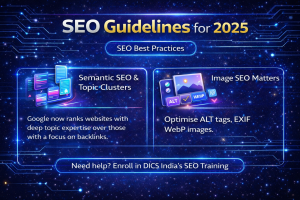
    Predictive SEO & Keyword Forecasting

    AI tools now predict trending keywords before they trend.

    Our AI Tools Training Module teaches students how to utilize AI for SEO, advertising, & content.

    AI Video & Animation Dominance

    Short AI-generated videos and animations are trending.
     Learn AI animation in our AI Animation Course

    4. CONTENT GUIDELINES FOR 2025

    Multi-Format Content Strategy 

    Every idea should be reused across 8–10 formats: Reels, blogs, carousels, shorts, emails, etc.

    Voice Search Content

    Voice search now accounts for 45% of total searches.

    5. SEO GUIDELINES FOR 2025

    • Semantic SEO & Topic Clusters
    • Google now ranks websites with deep topic expertise over those with a focus on backlinks. 
    • Image SEO Matters
    • Optimise 
    • ALT tags
    • EXIF
    • WebP images
    • Need help? Enroll in DICS India’s SEO Training

    6. PAID ADS GUIDELINES FOR 2025

    AI Smart Ads Take Over Google & Meta now use machine learning to optimise campaigns automatically.

    First Party Data Dominates Email, WhatsApp, and CRM data are crucial due to privacy laws.

    7.CONSUMER BEHAVIOUR TRENDS 2025

    • People want answers fast.
    • Trust > Offers
    • AI-powered chatbots boost conversions by 40%

    To learn chatbot automation, explore DICS India’s Digital Marketing Diploma

    Why Choose DICS India for Digital Marketing in 2025?

    100% Practical Training

    You learn real SEO, ads, and social media techniques based on 2025 rules.

    AI-Integrated Curriculum

    From AI SEO to AI video creation — our students learn everything.

    Job Assistance + Freelancing Mentorship

    We prepare you for internships, interviews, and real client work.

    30+ Years of Excellence

    DICS India is one of Delhi’s most trusted institutes. IF you Want to master the latest digital marketing rules of 2025 and build a high-income career?
    Join the Digital Marketing Course at DICS India today!
    GTB Nagar, Delhi
    dicsindia.in
    Call us for a demo class or free counselling.

  • How to Optimize Your GMB Profile in 2025 (Most Students Don’t Know These Secrets!)

    How to Optimize Your GMB Profile in 2025 (Most Students Don’t Know These Secrets!)

    Have you ever searched for a café, coaching center, or institute near you… And the first 3 results instantly caught your attention?
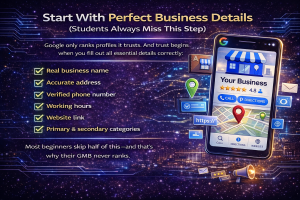
    That’s the power of Google My Business (GMB).

    And here’s the interesting part:
    Most businesses don’t even know how to optimize it properly.
    Which means you can master this skill and stand out instantly—whether you want to grow a business, boost your freelance career, or impress clients as a digital marketer.

    If you’re curious to know how GMB works and how to make it rank higher, keep reading. This guide reveals the exact steps professionals use to dominate local searches.

    Start With Perfect Business Details (Students Always Miss This Step)

    Google only ranks profiles it trusts.
    And trust begins when you fill out all essential details correctly:

    • Real business name
    • Accurate address
    • Verified phone number
    • Working hours
    • Website link
    • Primary & secondary categories

    Most beginners skip half of this—and that’s why their GMB never ranks.

    Write a Description That “Talks to Google”

    Your GMB description isn’t just for customers.
    It helps Google understand what you offer.

    Use this formula:

    What you do + Who you help + Where you are located + Main skill

    Example:
    “We help students learn advanced digital marketing and AI skills in Delhi through practical, job-focused training.”

    Simple. Powerful. Google loves this.

     Upload Photos That Make People Stop Scrolling

    Here’s a secret:
    People trust photos more than text.

    Upload:

    • Real classroom images
    • Students working
    • Events, certifications
    • Short videos of your campus or team

    Profiles with real photos get more clicks than profiles using stock images.

    Use GMB Posts (The Most Underrated Hack!)

    If you want your profile to look alive and active, post frequently.

    Post ideas:

    • New batches
    • Workshops
    • Student success stories
    • Behind-the-scenes shots
    • Discounts or free demo classes

    These posts build trust—and Google rewards you with better rankings.

     Reviews = Superpower for GMB Ranking

    If there’s one factor that can instantly boost your GMB visibility, it’s this:

    Authentic Google Reviews.

    Ask students or clients to share:

    • Their experience
    • What they learned
    • How your course helped
    • Their achievements

    Respond to every review—you’ll look more professional and Google will notice.

    Add Your Courses or Services (Students Don’t Even Know This Exists!)

    Many GMB profiles don’t use the “Services” or “Product” section at all.

    But if you use it correctly, your GMB will rank for multiple keywords.

    Example services:

    • Digital Marketing Course in Delhi
    • SEO Training
    • AI Tools Course
    • Computer Basics Program

    This helps you appear in more relevant searches.

     Track Insights Like a Pro

    Want to know:

    • How many students searched for you?
    • How many people clicked on your website?
    • Which keywords do they use?

    GMB Insights shows everything.

    Once you understand this data, you can optimize your profile like a real digital marketer.

    Why Students Should Learn GMB Optimization Right Now

    Because in 2025:

    • Every business wants local visibility
    • Every institute wants more walk-ins
    • Every startup needs local branding
    • Every freelancer wants high-paying clients

    And the exciting part?

    Very few people know advanced GMB optimization.
    This gives YOU an unfair advantage.

    You can use this skill to:

    • Rank your own business
    • Get clients as a freelancer
    • Boost your resume
    • Start earning even before completing your course

     Want to Master GMB Optimization From Scratch?

    If this sparked your curiosity, then you’ll love learning the complete, practical version inside our Digital Marketing Course at DICS India.

    Join DICS India’s Digital Marketing Course

    Learn:

    • Local SEO
    • GMB Ranking Techniques
    • AI Tools
    • Real Client Strategies
    • 100% Practical Training

     Perfect for beginners, students, & freelancers.

     Visit Now: dicsindia. in
     Book Your Free Demo Class!

  • Best AI Tools for Digital Marketers in 2025

    Best AI Tools for Digital Marketers in 2025

    Best AI Tools for Digital Marketers in 2025 — Transforming Marketing with Intelligence


    The Future of Marketing Is Intelligent

    In today’s fast-evolving digital landscape, marketing success depends on how intelligently you can use data, automate processes, and personalize experiences. Artificial Intelligence (AI) is the engine powering this new era of marketing. From predicting customer behaviour to generating campaign content, AI tools are redefining what efficiency and creativity mean for every digital marketer.

    “AI doesn’t make marketing easier; it makes it smarter.” Let’s explore the most effective AI tools every digital marketer should use in 2025 and why mastering them is crucial for your career growth

    ChatGPT — Content Creation & Customer Interaction

    ChatGPT has become an essential assistant for marketers. It helps generate blog posts, ad copies, email campaigns, and even automate customer chats.
    How to Use It:

    • Write compelling ad copy or blog introductions
    • Generate FAQs or social captions.
    • Build customer-service chatbots

    Pro Tip: Use ChatGPT to brainstorm ideas — then humanize and refine before publishing.

    Jasper AI — AI Copywriting Assistant

    Jasper AI is built specifically for marketing content. It creates persuasive product descriptions, ad headlines, and long-form blogs in your brand voice.
    Why Marketers Love It:

    • Templates for ads, blogs, and landing pages
    • Integrated SEO optimization
    • Fast content turnaround

    Combine Jasper with Surfer SEO for data-backed content that ranks.

    Canva AI & Magic Studio — Smart Visual Design

    Not a designer? Canva AI makes you one. Its Magic Write and Magic Design features automatically create stunning visuals and copy suggestions.
    Features:

    • Auto-resize social posts
    • AI photo edit & background removal
    • Magic presentation generator

    A must-have for social-media marketers and content creators.

    HubSpot AI & Marketing Hub

    HubSpot now integrates AI across CRM, email, and campaign automation.
    AI Capabilities:

    • Predictive lead scoring
    • Smart email personalization
    • AI-assisted workflows

    Use HubSpot AI to identify high-value leads and tailor messages that convert.

    ManyChat & Botpress — AI Chatbot Engagement

    Chatbots driven by AI can manage thousands of customer conversations simultaneously.
    Why It Matters:

    • Automates lead generation on WhatsApp, Instagram, and Messenger
    • Personalizes replies with user data
    • Integrates with CRM systems

    An essential tool for real-time engagement and conversion.

    Surfer SEO & Frase — AI SEO Optimization

    These AI-powered tools analyze top-ranking pages and suggest content structures, keyword density, and headings.
    Benefits:

    • Real-time SEO scoring
    • Topic clustering & keyword intent mapping
    • Fast content optimization

    When paired with human creativity, they turn SEO into a strategic advantage.

    Writesonic & Copy.ai — Ad and Email Automation

    For PPC and email campaigns, AI copy tools can generate dozens of creative versions.
    Best For:

    • Google Ads & Meta Ads copy
    • Cold emails & drip campaigns
    • A/B testing multiple headlines

    Result: higher CTRs and faster campaign deployment.

    Pictory & Synthesia — AI Video Marketing

    Video is the most consumed digital content — and AI tools make production faster.
    Features:

    • Convert blog text into professional videos
    • Create AI presenters and voice-overs.
    • Auto-generate subtitles

    Marketers can now produce video ads and explainers in hours, not days.

    Google Analytics 4 & BigQuery AI

    Data drives decisions. GA4 and BigQuery’s ML models provide predictive insights such as churn probability and purchase likelihood.
    Use Cases:

    • Identify high-value customers
    • Optimize remarketing campaigns
    • Measure ROI across channels.

    Perfect for marketers focused on performance analytics.

    AdCreative.ai — AI for Ad Design & Testing

    AdCreative.ai automates ad-banner and copy creation based on brand data.
    Why Use It:

    • Generates hundreds of creative variations instantly
    • Uses conversion data to optimize visuals
    • Integrates with Facebook Ads & Google Ads

    Boosts productivity and ad performance simultaneously.

    Bonus: DALL·E & Adobe Firefly for Creative Inspiration

    Both tools empower marketers to visualize ideas, create mood boards, or produce unique campaign imagery ethically.

    The next generation of marketing creativity will come from professionals who can think visually and act technically.

    How AI Makes Marketers More Valuable

    AI doesn’t remove the human touch — it amplifies it. Digital marketers who combine creativity with analytical skill become indispensable.
    Key Benefits:

    • Faster campaign execution
    • Better targeting accuracy
    • Data-driven decision-making
    • Improved ROI & efficiency

     Learn AI-Driven Digital Marketing at DICS

    If you want to master these tools and gain practical experience, enroll in the Digital Marketing with AI Program at DicsIndia.
    Guided by trained faculty, this program combines live projects, certification, and placement assistance to prepare you for the next decade of intelligent marketing.

     FAQs

    Q1. Which AI tool is best for digital marketing beginners?
    ChatGPT and Canva AI — easy to learn and immediately useful for content and visuals.

    Q2. Do AI tools replace human marketers?
    No. They automate repetitive work; creativity and strategy remain human strengths.

    Q3. Can AI help with SEO?
    Yes. Tools like Surfer SEO and Frase analyze top-ranking content to improve your on-page optimization.

    Q4. Which is the best AI tool for video marketing?
    Pictory and Synthesia — they turn text into video within minutes.

    Q5. Where can I learn Digital Marketing with AI in Delhi?
    Join the certified program at DicsIndia.in — India’s trusted institute for AI-driven digital skills training.

    FOR MORE INFO CONTACT US

  • Digital Marketing with AI | Learn Future Marketing at DICS

    Digital Marketing with AI | Learn Future Marketing at DICS

    Digital Marketing with AI:

    We are living through a fundamental shift in how organisations reach, understand, and serve people. Digital marketing is no longer just “posting and promoting” — it is a discipline powered by artificial intelligence that turns data into insight, insight into strategy, and strategy into measurable impact. As someone who has spent decades building education and career pathways, I see AI not as a replacement for human creativity but as a multiplier of human judgment. In this article, I’ll explain why AI matters for digital marketing, what it enables today, practical steps to adopt it, and where learners and marketers should focus their energy.

    Why AI is a game-changer for digital marketing

    At its heart, marketing is about relevance: the right message, to the right person, at the right time. AI dramatically improves relevance by:

    • Personalization at scale. AI systems analyze behaviour, preferences, and context to deliver tailored content — from personalized emails to dynamically customized web pages. This raises conversion rates while improving user experience.
    • Automation of repetitive, high-volume tasks. Campaign setup, bid optimization, A/B testing, and reporting can be automated, freeing human teams to focus on strategy and creativity.
    • Data-driven predictive insights. Machine learning models forecast customer intent, lifetime value, and churn risk — enabling smarter budgeting and prioritization.
    • Creative augmentation. Generative AI supports idea generation, copywriting, image creation, and video storyboards — accelerating content production while keeping humans in the creative loop.
    • Better measurement and attribution. AI models help untangle multi-touch customer journeys and attribute value more accurately across channels.

     AI makes marketing more intelligent, faster, and more accountable.

    Real-world AI use-cases marketers should prioritize

    If you’re implementing AI today, start with high-value, low-risk use cases:

    1. Automated audience segmentation. Use clustering models to find natural customer groups and tailor messaging.
    2. AI-assisted content creation. Tools like large language models help draft headlines, email copy, meta descriptions, and social posts — edit and humanize the output.
    3. Programmatic bidding & budget optimization. Let ML optimize bid strategies across search and display for defined KPIs.
    4. Predictive lead scoring. Identify prospects most likely to convert and route them to sales or nurture programs.
    5. Chatbots & conversational engagement. Deploy chat assistants for first-contact queries and lead capture; escalate complex cases to humans.
    6. Creative variants & visual generation. Use generative tools to rapidly generate image and video ideas, then refine them for brand fit.

    These implementations deliver measurable uplift and free teams to focus on strategy, partnerships, and brand-building.

    The tech stack: tools to consider

    A modern AI-enabled marketing stack typically includes:

    • Data & analytics: GA4, BigQuery, Power BI / Data Studio
    • Automation & orchestration: Marketing automation platforms (email/CRM integrations)
    • AI copy & creative: Large language models (LLMs), Jasper, Writesonic, ChatGPT; image generators like Midjourney/Firefly
    • Ad & bidding platforms: Google Ads Smart Bidding, Meta Advantage+
    • Conversational AI: ManyChat, Dialogflow, Botpress
    • Experimentation & personalization: AB testing platforms and personalization engines

    As a rule, choose tools that integrate with your data sources and respect user privacy.

    How to get started — a practical 4-step roadmap

    1. Audit your data & objectives. Inventory customer touchpoints and define clear KPIs (lead quality, CAC, retention).
    2. Pilot a single high-impact use case. Start small: predictive lead scoring or a chatbot pilot. Measure, learn, iterate.
    3. Scale what works. Expand successful pilots into cross-channel automation and personalization.
    4. Invest in talent & governance. Train your team in AI literacy and set governance policies for fair, transparent use.

    Learning by doing — with measurable experiments — is more effective than chasing every new tool.

    Careers & learning: where to focus your skills

    For learners and professionals, the intersection of marketing + AI is a rich career path. Key skills include:

    • Digital marketing fundamentals (SEO, SEM, social media)
    • Data literacy (SQL basics, spreadsheets, analytics)
    • Familiarity with AI tools (prompting, fine-tuning workflows)
    • Measurement frameworks & experimentation design
    • Communication and creative strategy

    If you wish to build these competencies with structured support, explore practical courses and mentorship at institutions like DICS INDIA.

    Ready to master Digital Marketing with AI? Join our next cohort at DICS — practical, project-based learning with internships and placement support. Visit dicsindia.in to view the syllabus, request a demo class, or speak with an admissions advisor today.

    Frequently Asked Questions (FAQs)

    Q1: Will AI replace marketers?
    A1: No. AI automates routine work and amplifies outcomes, but human strategy, ethics, and creativity remain central. The best teams combine human judgment with AI capability.

    Q2: Which AI tools should beginners start with?
    A2: Start with tools that amplify productivity: content helpers (LLMs like ChatGPT), visual assistants (Canva AI), and simple automation within your email or ads platform.

    Q3: Do I need to learn coding to use AI in marketing?
    A3: Not necessarily. Many AI tools are no-code. However, basic data skills (spreadsheets, understanding metrics) unlock far greater potential.

    Q4: How do I measure AI-driven marketing success?
    A4: Define KPIs (conversion rate, CAC, LTV), run controlled experiments (A/B tests), and use attribution models to quantify incremental impact.

    Q5: What about data privacy and compliance?
    A5: Always follow local regulations and platform policies. Use consent mechanisms, anonymize data when possible, and maintain clear privacy documentation.

    AI is not a fad — it is a foundational change in how we listen to and serve customers. For educators, marketers, and students, the opportunity is to learn fast, experiment ethically, and create measurable value. If you want practical guidance or a tailored learning path in Digital Marketing with AI. VISIT  DICSINDIA.IN


Delhi Institute of Computer Science-LOGO
student of dics
alumni of dics
ex student of dics
75+

Talk to our Expert

Take the first step towards a smarter Future 🚀

By submitting the form, you agree to our Terms and Conditions and our Privacy Policy.